

Term 1 | Level 1 | Phonics focus: blends, plurals -s and -es
Lesson 3 – Stories and Rhymes | Lessons – Index
Lessons
This page has the two reading lessons in Lesson 3, Stories and Rhymes: Lessons 3.1 and 3.2. The Lesson 3 page has the Lesson 3 overview, the Lesson 3 review and the PDF download.
Select a lesson to go straight to it. Each lesson ends with a link back to the top of the page.
Lesson 3.1: Story Order: Beginning, Middle, End
Reading | About 20 minutes
Term 1 | Level 1
Goal
“I can find the beginning, the middle and the end of a short story.”
Words to know
story, beginning, middle, end
Wonder
Think about this question before you start. Say your ideas. You will come back to it at the end of the lesson.
What makes a story a story?
Let’s Learn
A story has three parts.
The beginning tells us who is in the story and how it starts.
The middle tells us what happens next.
The end tells us how the story finishes.
See How It’s Done
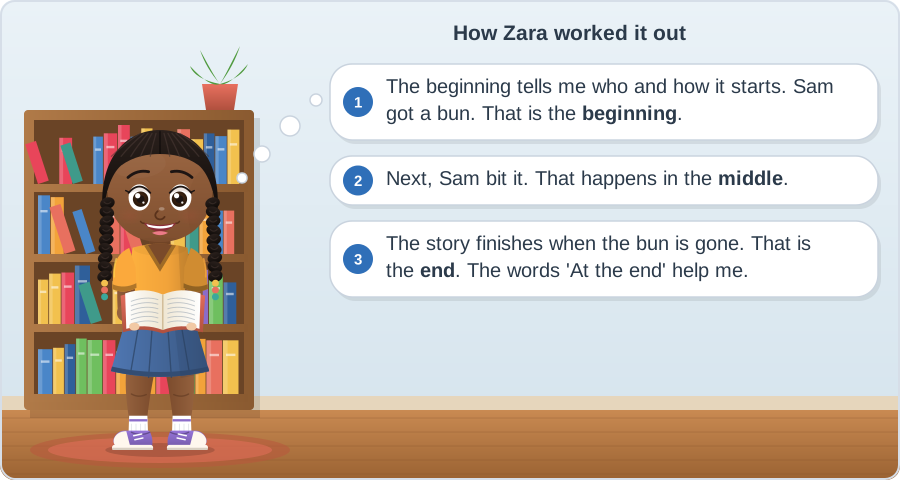
Sam got a bun. Sam bit it. At the end, the bun was gone.
Now Try It
Listen as an adult reads the story. Then answer the questions.
Pip the cat sat on a mat. Pip saw a bug. Pip ran after the bug.
1. What happens at the beginning?
Hint: Look at the first sentence. Who is in the story?
2. What happens at the end?
Hint: Look at the last sentence.
Time To Practise
Name: ______________________
Read with an adult.

Kim had a seed. She put it in a pot of mud. Kim got the mud wet. The pot sat in the sun. A little stem popped up. The stem got big and tall. At the end, a red flower was on top.
1. Match the part to the picture.
Write the letter.
Beginning ____ Middle ____ End ____
2. Beginning, middle or end?
Write B for beginning, M for middle or E for end.
____ A little stem popped up.
____ Kim had a seed.
____ At the end, a red flower was on top.
3. Draw and write the end.
Draw what happens at the end of the story.
Word bank: big | flower | red | top
At the end, ______________________________.
Reflect
Think about these questions. Talk about them with someone at home or at school.
1. Go back to the Wonder question: “What makes a story a story?” What do you think now?
2. I was a thinker today when I ______________________________.
A thinker thinks carefully to work things out. For example: I was a thinker today when I worked out the beginning, middle and end of the story.
Take action: Tell a short story to a younger child or a toy. Give it a clear beginning, middle and end.
Next Steps
If this was easy, try: Read a favourite picture book. Stop after each part and ask: Is this the beginning, the middle or the end?
If this was hard, go back to: See How It’s Done. Act out the bun story with a real snack. Say “beginning”, “middle” and “end” at each step.
Notes for Parents and Teachers
Show notes for parents and teachers
These notes cover this lesson only. How every lesson runs is explained in How to Use This Material.
Let’s Learn
Point to each box as you say it.
See How It’s Done
Read the story aloud. Then point to each picture as you go through Zara’s thoughts.
Now Try It
Read the story aloud. The learner answers.
Answer Key
Reveal Answers
Now Try It
1. Pip the cat sat on a mat.
2. Pip ran after the bug.
1. Match the part to the picture
Beginning B, Middle C, End A
Look for: the learner retells the story using the three cards in order: B, C, A.
2. Beginning, middle or end?
M A little stem popped up.
B Kim had a seed.
E At the end, a red flower was on top.
3. Draw and write the end
Sample answer: At the end, a red flower was on top.
Look for: a drawing of a flower on a stem, and a sentence about the flower. Accept “At the end, the stem got a red flower.”
Reflect
2. Any real moment from the lesson that shows the learner was a thinker. Examples: “I was a thinker today when I worked out the beginning, middle and end of the story.” “I was a thinker today when I put the story pictures in order.”
Lesson 3.2: Words That Rhyme
Reading | About 20 minutes
Term 1 | Level 1
Goal
“I can hear and find words that rhyme.”
Words to know
rhyme, end sound, poem
Wonder
Think about this question before you start. Say your ideas. You will come back to it at the end of the lesson.
Why do so many songs and poems rhyme?
Let’s Learn
Words rhyme when they end with the same sound.
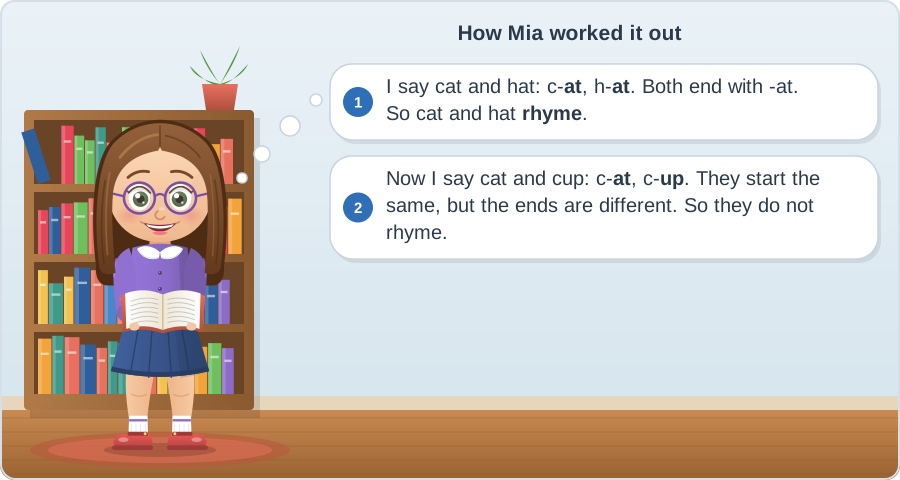
Cat, hat and mat rhyme. They all end with -at.
To check, say both words. Listen to the end. If the ends sound the same, the words rhyme.
Poems and songs often use rhyming words.
See How It’s Done
Now Try It
1. Do pig and wig rhyme?
Hint: Say both words. Do they end with the same sound?
2. Which word rhymes with sun: run or sit?
Hint: Sun ends with -un. Which word ends the same way?
Time To Practise
Name: ______________________
Read with an adult.
Snug as a Bug
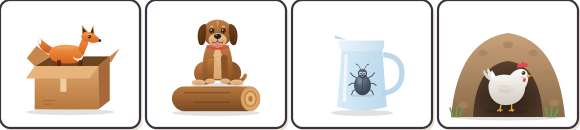
A fox in a box.
A dog on a log.
A bug in a jug
sat snug on a rug.
A hen in a den
had a nap at ten.
1. Circle the word that rhymes.
a) pig: pen wig pot
b) cat: hat cup dog
c) sun: sit sad run
d) log: leg lip dog
2. Find the rhymes in the poem.
Word bank: den | box | rug
a) fox rhymes with ____________
b) bug rhymes with ____________
c) hen rhymes with ____________
3. Make a rhyme.
Listen as an adult names each picture.
Finish the line with a word that rhymes with cat. Use a picture to help.
A cat on a ____________.
Now draw your rhyme.
Reflect
Think about these questions. Talk about them with someone at home or at school.
1. Go back to the Wonder question: “Why do so many songs and poems rhyme?” What do you think now?
2. I was a communicator today when I ______________________________.
A communicator shares ideas clearly by talking, writing or drawing. For example: I was a communicator today when I read the rhyming poem aloud.
Take action: Teach your rhyme to a family member and say it together.
Next Steps
If this was easy, try: Ask an adult to say a word. Think of as many rhymes as you can, such as hop: top, mop, pop, stop.
If this was hard, go back to: See How It’s Done. Ask an adult to say two words. Give a thumbs up if they rhyme and a thumbs down if they do not. Start with -at words and -ig words.
Notes for Parents and Teachers
Show notes for parents and teachers
These notes cover this lesson only. How every lesson runs is explained in How to Use This Material.
Let’s Learn
Stress the end of each word.
See How It’s Done
Point to each picture as you go through Mia’s thoughts.
Answer Key
Reveal Answers
Now Try It
1. Yes. Both end with -ig.
2. run
1. Circle the word that rhymes
a) wig
b) hat
c) run
d) dog
Look for: a learner who picks a word with the same first sound, such as “pen” for pig. Say both words again and stress the ending.
2. Find the rhymes in the poem
a) box
b) rug (also accept jug or snug)
c) den (also accept ten)
3. Make a rhyme
Sample answer: A cat on a mat.
Look for: any word ending in -at, such as mat, hat or bat. The drawing matches the line.
Reflect
2. Any real moment from the lesson that shows the learner was a communicator. Examples: “I was a communicator today when I read the rhyming poem aloud.” “I was a communicator today when I said my own pair of rhyming words.”
For Teachers: IB Details
Show IB and curriculum details
IB theme: How we express ourselves. This theme is about how we find and share ideas, feelings and beliefs: through imagination and creativity, the different ways we communicate, and how other people respond.
Central idea: People use stories and rhymes to share ideas, feelings and imagination.
| Lesson | Title | Strand | Key concept |
|---|---|---|---|
| 3.1 | Story Order: Beginning, Middle, End | Reading | Form |
| 3.2 | Words That Rhyme | Reading | Form |
Each lesson also matches the national curriculum for England (Year 1) and the US Common Core (Grade 1). The Grade 1 Curriculum Map lists the full standards for every lesson.
← Back to Lesson 3 – Stories and Rhymes | Lessons – Index
© 2026 Firefly Ed. All rights reserved. This page may be printed for personal, home and classroom use. It may not be sold, shared online or reproduced for commercial use without written permission. edfirefly.com


Share your thoughts or ask something..