

Term 3 | Level 3 | Phonics focus: oo, ou/ow, oi/oy, aw/au, ew/ue, days of the week
Lesson 7 – Weather and Seasons | Lessons – Index
Lessons
This page has the two listening and speaking lessons in Lesson 7, Weather and Seasons: Lessons 7.5 and 7.6. The Lesson 7 page has the Lesson 7 overview, the Lesson 7 review and the PDF download.
Select a lesson to go straight to it. Each lesson ends with a link back to the top of the page.
Lesson 7.5: Recite a Poem
Oral | About 20 minutes
Term 3 | Level 3
Goal
“I can learn a poem by heart and recite it clearly, with expression and actions.”
Words to know
recite, memory, expression, pause
Wonder
Think about this question before you start. Say your ideas. You will come back to it at the end of the lesson.
What does a seed need to grow?
Let’s Learn
To recite a poem means to say it out loud from memory, without reading it.
Here is how to learn a poem: read it a few times, then learn two lines at a time. Rhymes help you remember, because the lines rhyme in pairs.
When you recite, stand tall, look at your listeners, speak clearly and pause at the end of each line. Use expression: say a quiet line softly and an exciting line with more energy. Actions help too.
See How It’s Done
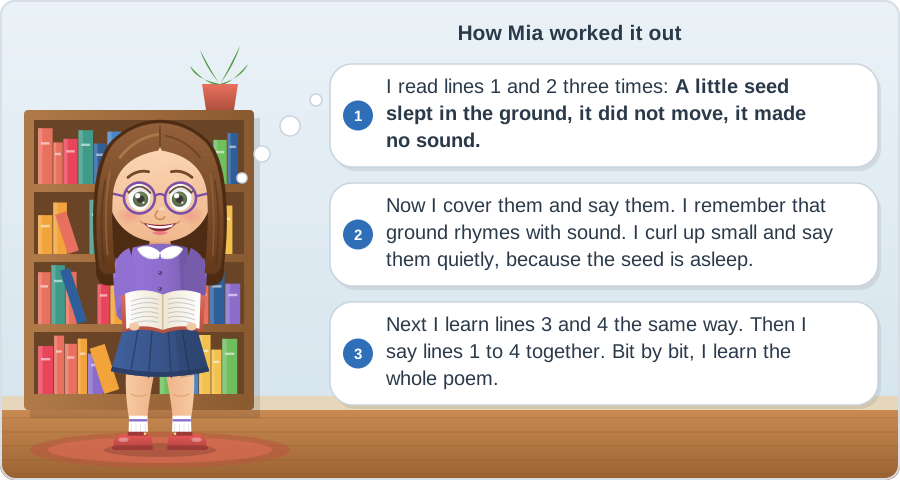
First, listen as an adult reads the poem aloud.
The Little Seed
A little seed slept in the ground,
It did not move, it made no sound.
The rain came down, drip, drip, drip,
The seed woke up and had a sip.
The sun came out, so warm and bright,
The seed grew up towards the light.
A stem, a leaf, a bud, a flower,
It grew a little every hour!
Now Try It
Say each pair of lines with an adult. Do the actions together.
| Lines | Action |
|---|---|
| 1 and 2 | Curl up small on the floor and stay still. |
| 3 and 4 | Wiggle your fingers down like rain, then sit up and pretend to sip. |
| 5 and 6 | Make a big circle with your arms for the sun, then stretch up tall. |
| 7 and 8 | Open your hands like a flower, one finger at a time. |
1. Say lines 1 and 2 with an adult, doing the action. Then say them on your own, without looking.
Hint: If you get stuck, think of the rhyme: ground … sound.
2. Now learn lines 3 and 4. Say lines 1 to 4 together.
Hint: The rain goes drip, drip, drip. What does the seed do? It has a …
Time To Practise
Name: ______________________
1. How does the seed change?
Number the pictures 1 to 4 to show how the seed changes in the poem.
a) ____ b) ____ c) ____ d) ____
2. Say it from memory.
Cover the poem. Listen as an adult reads each line and stops at the gap. Say the missing word, and then write it.
A little seed slept in the ______________,
It did not move, it made no ______________.
The rain came down, drip, drip, drip,
The seed woke up and had a ______________.
The sun came out, so warm and bright,
The seed grew up towards the ______________.
A stem, a leaf, a bud, a flower,
It grew a little every ______________!
3. Recite the poem.
Practise the whole poem with actions. Then recite it to an adult or your family. Say the last two lines with no help at all.
☐ I said the whole poem from memory.
☐ I said the last two lines on my own.
☐ I used actions.
☐ I spoke clearly and paused at the end of each line.
☐ I used expression: quiet for the sleeping seed, bright for the sun.
After you recite, tell your listener in two or three sentences what the seed needed to grow.
Reflect
Think about these questions. Talk about them with someone at home or at school.
1. Go back to the Wonder question: “What does a seed need to grow?” What do you think now?
2. I was a risk-taker today when I ______________________________.
A risk-taker tries something new, even when it feels hard. For example: I was a risk-taker today when I said the poem aloud to someone.
Take action: Plant a seed in a pot with an adult. Say the poem to it each day and watch it grow.
Next Steps
If this was easy, try: Learn a second poem by heart, such as a nursery rhyme or a poem from a library book. Recite both poems to your family.
If this was hard, go back to: Now Try It. Learn just two lines a day with the actions. Say the new lines and all the old lines each day.
Notes for Parents and Teachers
Show notes for parents and teachers
These notes cover this lesson only. How every lesson runs is explained in How to Use This Material.
Let’s Learn
Point to each picture to show how the seed grows.
See How It’s Done
Read the poem aloud before Mia’s thoughts.
Now Try It
Do the actions together as you say each pair of lines.
Time To Practise
- Task 2: Cover the poem. Read each line and pause at the gap. The learner says the missing word from memory, then writes it.
Answer Key
Reveal Answers
Now Try It
1. A little seed slept in the ground, it did not move, it made no sound.
2. The rain came down, drip, drip, drip, the seed woke up and had a sip.
1. How does the seed change?
a) 3
b) 1
c) 4
d) 2
2. Say it from memory
ground, sound, sip, light, hour
Look for: the missing words said from memory before they are written. Accept any spelling attempt for hour, as it has a silent h.
3. Recite the poem
Look for: the whole poem in the right order, the last two lines with no help, a clear voice and some expression. Sample answer for the talk: The seed needed rain to drink. It needed the sun to be warm. It needed time to grow into a flower.
Note: this poem was written for this lesson. The learner can recite it at a family gathering or add a new verse.
Reflect
2. Any real moment from the lesson that shows the learner was a risk-taker. Examples: “I was a risk-taker today when I said the poem aloud to someone.” “I was a risk-taker today when I said the lines from memory, even though it was hard.”
Lesson 7.6: Say It Right: He Runs, They Run
Oral | About 20 minutes
Term 3 | Level 3
Goal
“I can choose and say the right action word for one person or more than one.”
Words to know
one, more than one, action word, -s
Wonder
Think about this question before you start. Say your ideas. You will come back to it at the end of the lesson.
Why does a small word like runs or run matter when we speak?
Let’s Learn
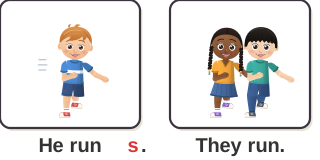
When we talk about one person or thing, using he, she, it or a name, the action word usually ends in s: he runs, she likes, the wind blows.
When we talk about more than one, or use I, you, we or they, there is no s: they run, we like, the clouds move.
Saying it right helps people understand us. Listen to how the sentence sounds. If it sounds wrong, check: one or more than one?
See How It’s Done

Now Try It
Listen as an adult reads both choices. Say the right one.
1. Say the right one: “The birds sing.” or “The birds sings.”
Hint: How many birds? One, or more than one?
2. Say the right one: “Mia like the snow.” or “Mia likes the snow.”
Hint: Mia is one person. Does the action word need an s?
Time To Practise
Name: ______________________
1. Say it and circle it.
Say each sentence both ways. Circle the word that is right.
a) She (like / likes) ice cream on hot days.
b) They (run / runs) home in the rain.
c) The wind (blows / blow) the leaves off the tree.
d) We (plays / play) in the snow after school.
e) Tom (wear / wears) a hat in the sun.
f) The ducks (swim / swims) in the pond.
2. Fix it.
Each sentence has a mistake. Say it the right way, then write it.
a) He play football in the park.
______________________________________________
b) My friends likes to swim in summer.
______________________________________________
c) It snow a lot in winter.
______________________________________________
d) The cat sleep in the warm sun.
______________________________________________
3. Talk about a rainy day.
Tell an adult what people in your home do on a rainy day. Say six sentences. Talk about one person in three sentences and more than one person in three sentences.
Example: My mum reads a book. My brothers play a game.
Write two of your sentences.
______________________________________________
______________________________________________
☐ I said six sentences.
☐ I used the s with he, she and names.
☐ I did not use the s with they and we.
Reflect
Think about these questions. Talk about them with someone at home or at school.
1. Go back to the Wonder question: “Why does a small word like runs or run matter when we speak?” What do you think now?
2. I was knowledgeable today when I ______________________________.
Being knowledgeable means knowing things and using what you know. For example: I was knowledgeable today when I used he runs and they run the right way.
Take action: Listen to a weather report on the radio or TV. Say back one sentence using he, she or they correctly.
Next Steps
If this was easy, try: Listen to a weather report and say back three sentences with he, she or they, such as: The man says it will rain.
If this was hard, go back to: Let’s Learn. Use toys: move one toy and say “it jumps”, then move two toys and say “they jump”. Then try Task 1 again.
Notes for Parents and Teachers
Show notes for parents and teachers
These notes cover this lesson only. How every lesson runs is explained in How to Use This Material.
Let’s Learn
Point to the one child, then the two children.
See How It’s Done
Say both choices out loud before Ken’s thoughts.
Now Try It
Read both choices aloud. The learner says the right one.
Answer Key
Reveal Answers
Now Try It
1. The birds sing.
2. Mia likes the snow.
1. Say it and circle it
a) likes
b) run
c) blows
d) play
e) wears
f) swim
2. Fix it
a) He plays football in the park.
b) My friends like to swim in summer.
c) It snows a lot in winter.
d) The cat sleeps in the warm sun.
3. Talk about a rainy day
Sample answer: My mum reads a book. My dad cooks soup. My sister draws a picture. We play a board game. My brothers build a den. They watch the rain.
Look for: correct endings when the learner speaks, not only when they write. If the learner makes a mistake, repeat the sentence the right way and ask them to say it again. Note: in some home languages and dialects, the -s ending is not used. This lesson teaches the form used in standard written English.
Reflect
2. Any real moment from the lesson that shows the learner was knowledgeable. Examples: “I was knowledgeable today when I used he runs and they run the right way.” “I was knowledgeable today when I knew when to add s to a verb.”
For Teachers: IB Details
Show IB and curriculum details
IB theme: How the world works. This theme is about how the natural world works: the patterns we can see in nature, such as weather and seasons, and how these patterns affect people, plants and animals.
Central idea: Weather and seasons change in patterns, and these changes affect how people and other living things live.
| Lesson | Title | Strand | Key concept |
|---|---|---|---|
| 7.5 | Recite a Poem | Speaking | Change |
| 7.6 | Say It Right: He Runs, They Run | Speaking | Connection |
Each lesson also matches the national curriculum for England (Year 1) and the US Common Core (Grade 1). The Grade 1 Curriculum Map lists the full standards for every lesson.
← Back to Lesson 7 – Weather and Seasons | Lessons – Index
© 2026 Firefly Ed. All rights reserved. This page may be printed for personal, home and classroom use. It may not be sold, shared online or reproduced for commercial use without written permission. edfirefly.com


Share your thoughts or ask something..