
Term 2 | Level 2 | Phonics focus: ai/ay, ee/ea, oa/ow, -ing, -ed
Lesson 5 – Food and Celebrations | Lessons – Index
Lessons
This page has the two listening and speaking lessons in Lesson 5, Food and Celebrations: Lessons 5.5 and 5.6. The Lesson 5 page has the Lesson 5 overview, the Lesson 5 review and the PDF download.
Select a lesson to go straight to it. Each lesson ends with a link back to the top of the page.
Lesson 5.5: Polite Requests
Oral | About 20 minutes
Term 2 | Level 2
Goal
“I can change a bossy sentence into a polite request.”
Words to know
polite, request, please, thank you
Wonder
Think about this question before you start. Say your ideas. You will come back to it at the end of the lesson.
How do our words make other people feel?
Let’s Learn
When we ask for something, we can sound bossy or polite.
A polite request uses kind words: Could I, May I, please and thank you.
We also use a calm, friendly voice and look at the person. Polite words help people feel respected and happy to help.
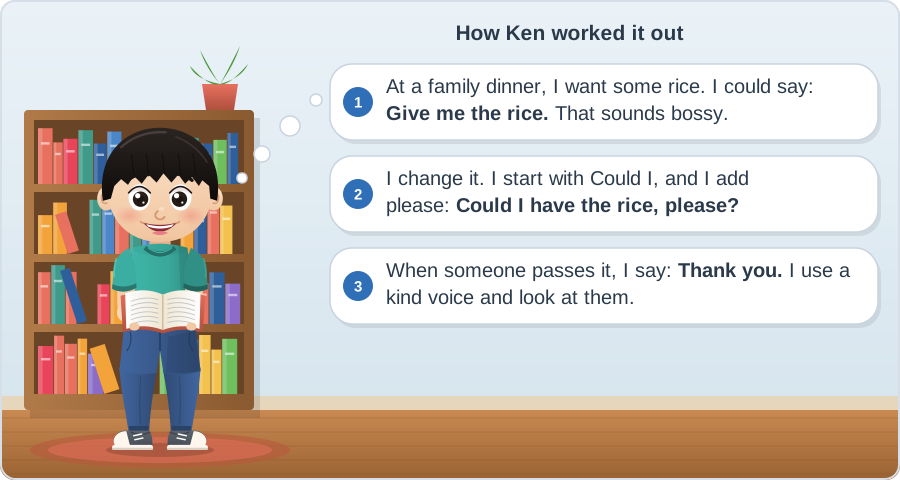
See How It’s Done
Now Try It
1. Change this to a polite request: “Pass the water.”
Hint: Start with “Could you…” and end with “please”.
2. What do you say after someone helps you?
Hint: Two words.
Time To Practise
Name: ______________________
1. Tick the polite request.
a)
☐ Give me some cake.
☐ Could I have some cake, please?
☐ Cake now!
b)
☐ May I play with your ball, please?
☐ Give me your ball.
☐ Ball!
2. Make it polite.
Write each bossy sentence as a polite request.
a) “Move over.” ______________________________________________
b) “Give me the pen.” ______________________________________________
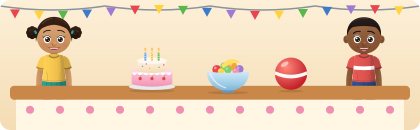
3. Party role play.
Play a pretend party with an adult, who is the host. Ask politely for each thing below.
☐ Ask for a drink.
☐ Ask to sit next to someone.
☐ Ask for a second piece of cake.
☐ Say thank you each time.
Write one polite request you used.
______________________________________________
Reflect
Think about these questions. Talk about them with someone at home or at school.
1. Go back to the Wonder question: “How do our words make other people feel?” What do you think now?
2. I was caring today when I ______________________________.
Being caring means being kind and helping others. For example: I was caring today when I asked for something with please and thank you.
Take action: Use polite requests at every meal this week. Notice how people answer you.
Next Steps
If this was easy, try: Play shop at home. The shopper must make a polite request to buy each thing, and the shopkeeper says “You are welcome.”
If this was hard, go back to: See How It’s Done. Practise only one polite starter, “Could I have …, please?”, with real things at the table.
Notes for Parents and Teachers
Show notes for parents and teachers
These notes cover this lesson only. How every lesson runs is explained in How to Use This Material.
Let’s Learn
Say the bossy bubble in a bossy voice and the polite bubble in a kind voice.
See How It’s Done
Act out the dinner table as you go through Ken’s thoughts.
Time To Practise
- Task 3: Play the host at a pretend party. The learner asks politely for each thing. Hand it over only when the request is polite.
Answer Key
Reveal Answers
Now Try It
1. Could you pass the water, please?
2. Thank you.
1. Tick the polite request
a) Could I have some cake, please?
b) May I play with your ball, please?
2. Make it polite
a) Could you move over, please?
b) Could I have the pen, please?
Look for: a polite starter (Could, May or Can) and “please”. Accept “Please could I have the pen?”
3. Party role play
Sample answer: May I sit next to you, please?
Look for: a calm voice, eye contact and “thank you” after each request. The learner can also say why polite words matter.
Reflect
2. Any real moment from the lesson that shows the learner was caring. Examples: “I was caring today when I asked for something with please and thank you.” “I was caring today when I turned a bossy sentence into a kind, polite one.”
Lesson 5.6: Tell Me How to Make a Snack
Oral | About 20 minutes
Term 2 | Level 2
Goal
“I can explain out loud how to make a snack in four steps.”
Words to know
explain, steps, order word, doing word
Wonder
Think about this question before you start. Say your ideas. You will come back to it at the end of the lesson.
How can we explain something so someone else can do it?
Let’s Learn
When we explain how to make something, we give steps in order.
First, say what you need. Then give each step with an order word: First, Next, Then, Last.
Each step has a doing word, such as spread, put or cut. Speak clearly so your listener can follow you.
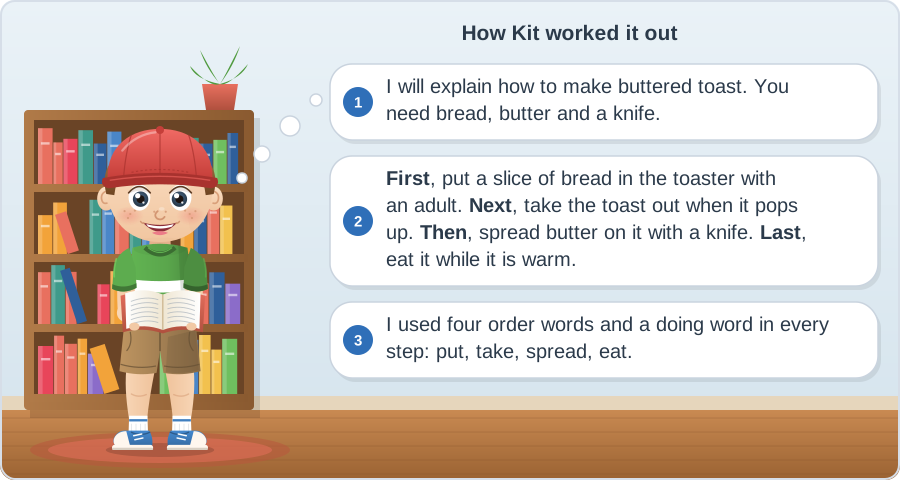
See How It’s Done
Now Try It
1. Say the first step for making a jam sandwich.
Hint: What do you need to get out before you spread the jam?
2. Which order word do we use for the final step?
Hint: It is the opposite of First.
Time To Practise
Name: ______________________
1. Put the steps in order.
These pictures show how to make a cheese sandwich. They are mixed up.
First ____ Next ____ Then ____ Last ____
2. Circle the doing word.
a) Spread the butter on the bread.
b) Put the cheese on top.
c) Cut the sandwich in half.
3. Tell someone how to make your snack.
Pick a snack you know how to make. Plan four steps. Then say them to an adult. The adult does exactly what you say, so be clear!
Word bank: spread | put | cut | pour | mix
My snack: ____________________ You need: ______________________________
First, ______________________________________________
Next, ______________________________________________
Then, ______________________________________________
Last, ______________________________________________
☐ I said what you need.
☐ I used four order words.
☐ The adult could follow my steps.
Reflect
Think about these questions. Talk about them with someone at home or at school.
1. Go back to the Wonder question: “How can we explain something so someone else can do it?” What do you think now?
2. I was a communicator today when I ______________________________.
A communicator shares ideas clearly by talking, writing or drawing. For example: I was a communicator today when I told someone how to make my snack, step by step.
Take action: Teach someone at home how to make your snack. Watch them follow your four steps.
Next Steps
If this was easy, try: Explain how to do something without food, such as brushing your teeth or planting a seed, in five steps.
If this was hard, go back to: See How It’s Done. Act out each step with real bread before saying it. Say one step at a time with an order word.
Notes for Parents and Teachers
Show notes for parents and teachers
These notes cover this lesson only. How every lesson runs is explained in How to Use This Material.
See How It’s Done
Count the steps on your fingers as you go through Kit’s thoughts.
Answer Key
Reveal Answers
Now Try It
1. Sample answer: First, get two slices of bread.
2. Last
1. Put the steps in order
First B, Next A, Then D, Last C
2. Circle the doing word
a) Spread
b) Put
c) Cut
3. Tell someone how to make your snack
Sample answer: My snack is a banana smoothie. You need a banana, milk, a blender and a cup. First, peel the banana. Next, put it in the blender with an adult. Then, pour in the milk. Last, blend it and pour it into a cup.
Look for: the steps are in a sensible order, each starts with an order word and has a doing word, and they are spoken clearly. If the adult gets stuck, the learner adds the missing detail.
Reflect
2. Any real moment from the lesson that shows the learner was a communicator. Examples: “I was a communicator today when I told someone how to make my snack, step by step.” “I was a communicator today when I used first, next, then and last when I talked.”
For Teachers: IB Details
Show IB and curriculum details
IB theme: How we express ourselves. This theme is about how we find and share ideas, feelings, culture and beliefs: through creativity, through the different ways we communicate, and through how others respond.
Central idea: People share food and celebrations to express who they are and what they value.
| Lesson | Title | Strand | Key concept |
|---|---|---|---|
| 5.5 | Polite Requests | Speaking | Perspective |
| 5.6 | Tell Me How to Make a Snack | Speaking | Function |
Each lesson also matches the national curriculum for England (Year 1) and the US Common Core (Grade 1). The Grade 1 Curriculum Map lists the full standards for every lesson.
← Back to Lesson 5 – Food and Celebrations | Lessons – Index
© 2026 Firefly Ed. All rights reserved. This page may be printed for personal, home and classroom use. It may not be sold, shared online or reproduced for commercial use without written permission. edfirefly.com


Share your thoughts or ask something..