
Term 2 | Level 2 | Phonics focus: a_e, i_e, o_e, u_e
Lesson 4 – Animals Around Us | Lessons – Index
Lessons
This page has the two viewing and presenting lessons in Lesson 4, Animals Around Us: Lessons 4.7 and 4.8. The Lesson 4 page has the Lesson 4 overview, the Lesson 4 review and the PDF download.
Select a lesson to go straight to it. Each lesson ends with a link back to the top of the page.
Lesson 4.7: Picture and Caption
Visual | About 20 minutes
Term 2 | Level 2
Goal
“I can compare a picture with its caption and find what the caption leaves out.”
Words to know
caption, picture, main idea, left out
Wonder
Think about this question before you start. Say your ideas. You will come back to it at the end of the lesson.
Does a caption tell us everything in a picture?
Let’s Learn
A caption is a short piece of writing next to a picture. It tells us what the picture shows.
A caption tells the main idea. It cannot tell us everything.
To compare, look at the picture closely. Then read the caption. Ask: What does the caption tell me? What does the picture show that the caption leaves out?
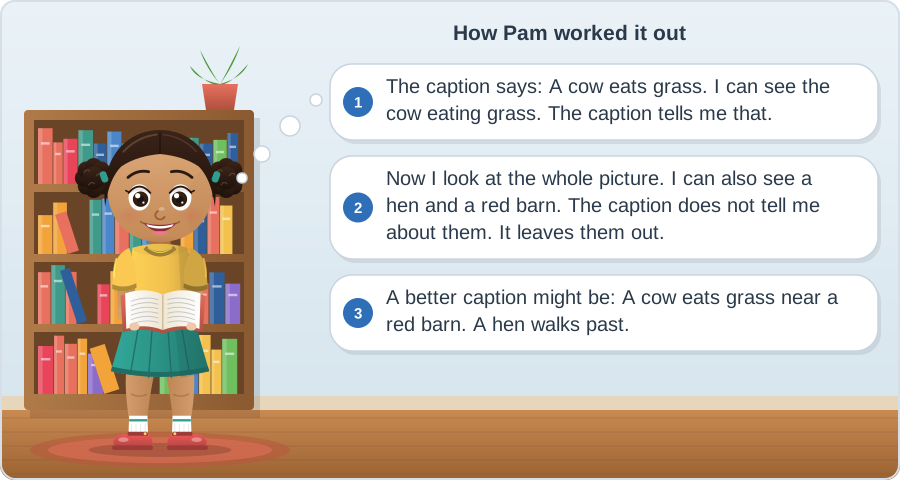
See How It’s Done
Now Try It
1. What does the caption tell you?
Hint: Read the caption. Point to that part of the picture.
2. Name one thing in the picture that the caption leaves out.
Hint: Look in the water and in the air.
Time To Practise
Name: ______________________
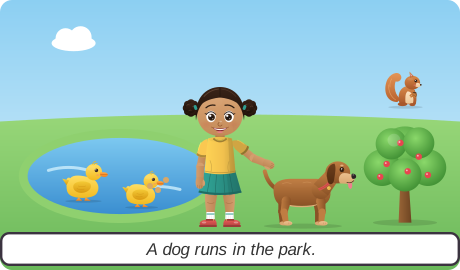
1. In the caption or left out?
Tick one box for each thing in the picture.
a) the ducks ☐ in the caption ☐ left out
b) the dog ☐ in the caption ☐ left out
c) the girl feeding the ducks ☐ in the caption ☐ left out
d) the squirrel in the tree ☐ in the caption ☐ left out
2. Tick the best caption.
Which caption tells the most about the picture?
☐ A dog runs in the park.
☐ A girl feeds the ducks while a dog runs past.
☐ It is a sunny day.
3. Write your own caption.
Write a caption of two sentences for the park picture. Tell the main things you see.
Word bank: ducks | squirrel | pond | bread
______________________________________________
______________________________________________
Say what your caption adds that the first caption left out.
Reflect
Think about these questions. Talk about them with someone at home or at school.
1. Go back to the Wonder question: “Does a caption tell us everything in a picture?” What do you think now?
2. I was a thinker today when I ______________________________.
A thinker thinks carefully to work things out. For example: I was a thinker today when I worked out what the caption tells us and what it leaves out.
Take action: Draw or take a picture of an animal outside. Write a caption that tells the most important thing.
Next Steps
If this was easy, try: Find photos with captions in a magazine or an animal book. For each one, say one thing the caption leaves out.
If this was hard, go back to: See How It’s Done. Cover the caption and name everything in the picture first. Then read the caption and tick off what it tells.
Notes for Parents and Teachers
Show notes for parents and teachers
These notes cover this lesson only. How every lesson runs is explained in How to Use This Material.
See How It’s Done
Point to each part of the farm picture as you go through Pam’s thoughts.
Answer Key
Reveal Answers
Now Try It
1. A frog sits on a lily pad.
2. the fish or the dragonfly
1. In the caption or left out?
a) left out
b) in the caption
c) left out
d) left out
2. Tick the best caption
A girl feeds the ducks while a dog runs past.
Look for: the learner says why. It tells about more of the picture than the other two captions.
3. Write your own caption
Sample answer: A girl feeds bread to the ducks on the pond. A dog runs past and a squirrel watches from a tree.
Look for: two sentences that name the main things in the picture, including at least one thing the first caption left out.
Reflect
2. Any real moment from the lesson that shows the learner was a thinker. Examples: “I was a thinker today when I worked out what the caption tells us and what it leaves out.” “I was a thinker today when I chose the best caption for the picture.”
Lesson 4.8: Words and Pictures Work Together
Visual | About 20 minutes
Term 2 | Level 2
Goal
“I can use labels and a picture together to show the parts of an animal.”
Words to know
label, line, part, picture
Wonder
Think about this question before you start. Say your ideas. You will come back to it at the end of the lesson.
How do labels help us learn from a picture?
Let’s Learn
Pictures and words can work together to teach us.
A label names one part of a picture. A line joins the label to the part.
The picture shows what the part looks like. The word tells us its name. Together, they help us learn faster than words or pictures alone.
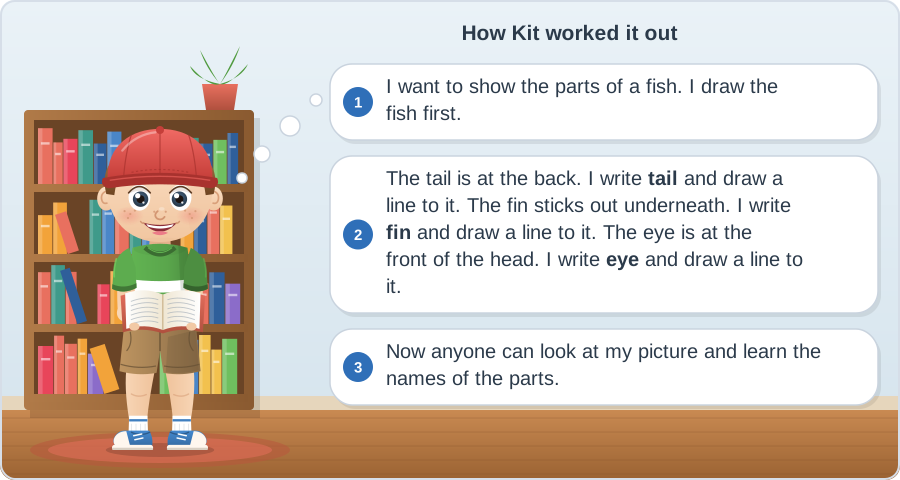
See How It’s Done
Now Try It
1. Point to where the label ear should go.
Hint: Look at the top of the cat’s head.
2. Point to where the label tail should go. Show where the line would go.
Hint: The line starts at the word and ends on the part.
Time To Practise
Name: ______________________
1. Label the bird.
Word bank: wing | feet | beak | tail
1. ____________ 2. ____________ 3. ____________ 4. ____________
2. Words and picture together.
Read the fact box. Then answer.
Fact box: A bird uses its wings to fly. It uses its beak to pick up food. Its feet hold on to branches.
a) Which part helps a bird hold on to a branch? Write its number from the picture. ______
b) A bird has no hands. How does it pick up a seed? Write one sentence.
______________________________________________
3. Draw and label.
Draw an animal. Label four parts. Then write one sentence about what one part does.
______________________________________________
Reflect
Think about these questions. Talk about them with someone at home or at school.
1. Go back to the Wonder question: “How do labels help us learn from a picture?” What do you think now?
2. I was a communicator today when I ______________________________.
A communicator shares ideas clearly by talking, writing or drawing. For example: I was a communicator today when I labelled the parts of the bird.
Take action: Make a labelled drawing of a pet or a garden animal. Teach someone the parts.
Next Steps
If this was easy, try: Make a labelled poster of an animal for a younger child. Add a fact box with two facts.
If this was hard, go back to: See How It’s Done. Label two parts only, such as the head and the tail. Add more labels when that is easy.
Notes for Parents and Teachers
Show notes for parents and teachers
These notes cover this lesson only. How every lesson runs is explained in How to Use This Material.
See How It’s Done
Draw the fish and add the labels as you go through Kit’s thoughts.
Answer Key
Reveal Answers
Now Try It
1. The learner points to the top of the cat’s head.
2. The learner points to the tail and traces a line from a word to it.
1. Label the bird
1. beak
2. wing
3. tail
4. feet
2. Words and picture together
a) 4 (the feet)
b) Sample answer: It picks up the seed with its beak.
Look for: the learner uses both the fact box and the picture. The fact box gives the job; the picture shows where the part is.
3. Draw and label
Sample answer: a drawing of a dog labelled ear, nose, tail and paw. A dog uses its nose to smell.
Look for: four labels, each joined to the right part with a line, and a sentence about what one part does.
Reflect
2. Any real moment from the lesson that shows the learner was a communicator. Examples: “I was a communicator today when I labelled the parts of the bird.” “I was a communicator today when I used words and a picture to share an idea.”
For Teachers: IB Details
Show IB and curriculum details
IB theme: Sharing the planet. This theme is about how we share the planet with other people and other living things: rights and responsibilities, living together fairly, and caring for nature.
Central idea: Animals share our world, and people can learn about them and care for them.
| Lesson | Title | Strand | Key concept |
|---|---|---|---|
| 4.7 | Picture and Caption | Viewing | Form |
| 4.8 | Words and Pictures Work Together | Presenting | Function |
Each lesson also matches the national curriculum for England (Year 1) and the US Common Core (Grade 1). The Grade 1 Curriculum Map lists the full standards for every lesson.
← Back to Lesson 4 – Animals Around Us | Lessons – Index
© 2026 Firefly Ed. All rights reserved. This page may be printed for personal, home and classroom use. It may not be sold, shared online or reproduced for commercial use without written permission. edfirefly.com

Share your thoughts or ask something..