

Term 3 | Level 3 | Phonics focus: contractions, two-syllable words, tricky word review
Lesson 9 – Our Community | Lessons – Index
Lessons
This page has the two writing lessons in Lesson 9, Our Community: Lessons 9.3 and 9.4. The Lesson 9 page has the Lesson 9 overview, the Lesson 9 review and the PDF download.
Select a lesson to go straight to it. Each lesson ends with a link back to the top of the page.
Lesson 9.3: Thank You, Helper
Writing | About 20 minutes
Term 3 | Level 3
Goal
“I can write a thank-you letter to a helper, with a greeting, a detail, how it helped and a closing.”
Words to know
thank-you letter, greeting, detail, closing
Wonder
Think about this question before you start. Say your ideas. You will come back to it at the end of the lesson.
How can we show helpers that we value their work?
Let’s Learn
A thank-you letter tells someone we are grateful for what they did. It helps people know their work matters.
A good thank-you letter has five parts: (1) a greeting, (2) thank you for what they did, (3) a detail about what they did, (4) how it helped or how you feel, and (5) a closing with your name.
A detail makes a thank-you letter special. It shows you really noticed what the person did.
See How It’s Done
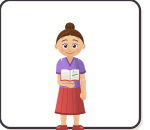

Dear Mrs Lee, Thank you for helping me learn to read. You read with me every day at break time, even when it was sunny outside. Now I can read my own books at bedtime. I feel proud. From Sam
Now Try It
1. Look at Arjun’s letter in Let’s Learn. Which part tells the detail of what Dr Rao did?
Hint: It is part 3. What did Dr Rao do?
2. Say a thank-you sentence for a bus driver. Include one detail.
Hint: What does a bus driver do for you? Do they wait, smile or drive safely?
Time To Practise
Name: ______________________
1. Name the parts.
Look at Arjun’s letter in Let’s Learn. Write the name of each part.
Word bank: closing | detail | greeting | how it helped | thank you
1. ______________ 2. ______________ 3. ______________ 4. ______________ 5. ______________
2. Choose a helper and plan.
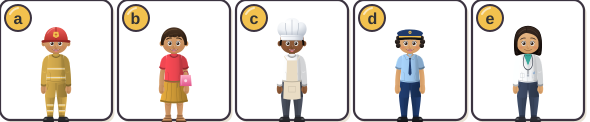
Choose one of these helpers, or a real helper you know.
Who: ______________________________
What they did: ______________________________________________
A detail: ______________________________________________
How it helped me: ______________________________________________
3. Write your letter.
Write your thank-you letter. Use all five parts. Write four to six sentences.
Dear ______________________,
______________________________________________
______________________________________________
______________________________________________
______________________________________________
______________________________________________
From ______________________
Reflect
Think about these questions. Talk about them with someone at home or at school.
1. Go back to the Wonder question: “How can we show helpers that we value their work?” What do you think now?
2. I was caring today when I ______________________________.
Being caring means being kind and helping others. For example: I was caring today when I wrote a thank-you letter to a helper.
Take action: Write a real thank-you letter to a helper in your community and give it to them.
Next Steps
If this was easy, try: Write a second thank-you letter to another helper, and post or deliver both letters.
If this was hard, go back to: Let’s Learn. Read Arjun’s letter again, then write just three parts: greeting, thank you and closing.
Notes for Parents and Teachers
Show notes for parents and teachers
These notes cover this lesson only. How every lesson runs is explained in How to Use This Material.
Let’s Learn
Point to each numbered part of the letter.
See How It’s Done
Write Sam’s letter on paper as you go through his thoughts, so that the learner can see it.
Answer Key
Reveal Answers
Now Try It
1. “You listened to my chest and gave me medicine.”
2. Sample answer: Thank you for waiting for me when I ran to the bus stop.
1. Name the parts
1. greeting
2. thank you
3. detail
4. how it helped
5. closing
2. Choose a helper and plan
Sample answer: Who: the postal worker. What they did: brings our letters. Detail: she brought my birthday parcel in the rain. How it helped: I got my present on my birthday.
3. Write your letter
Sample answer: Dear Postal Worker, Thank you for bringing our letters every day. On my birthday, you brought my parcel even though it was pouring with rain. It was a book from my grandma, and I read it that night. It made my birthday very special. From Maya
Look for: all five parts; a real detail; a comma after the greeting; four to six sentences with capital letters and full stops. If it is a real helper, help the learner give or post the letter.
Reflect
2. Any real moment from the lesson that shows the learner was caring. Examples: “I was caring today when I wrote a thank-you letter to a helper.” “I was caring today when I thought about how a helper makes my life better.”
Lesson 9.4: I Think… Because…
Writing | About 20 minutes
Term 3 | Level 3
Goal
“I can write my opinion about a topic and give two reasons for it.”
Words to know
opinion, fact, reason, because, also
Wonder
Think about this question before you start. Say your ideas. You will come back to it at the end of the lesson.
Why should we give a reason when we share an opinion?
Let’s Learn
A fact is true for everyone and can be checked: The park has three swings. An opinion is what someone thinks: The park is the best place in town.
When we write an opinion, we need reasons to show why we think it. Reasons help other people understand us, and they might even agree.
A strong opinion piece says what you think, gives two reasons with because and also, and ends with a sentence that sums it up, starting with so.
See How It’s Done
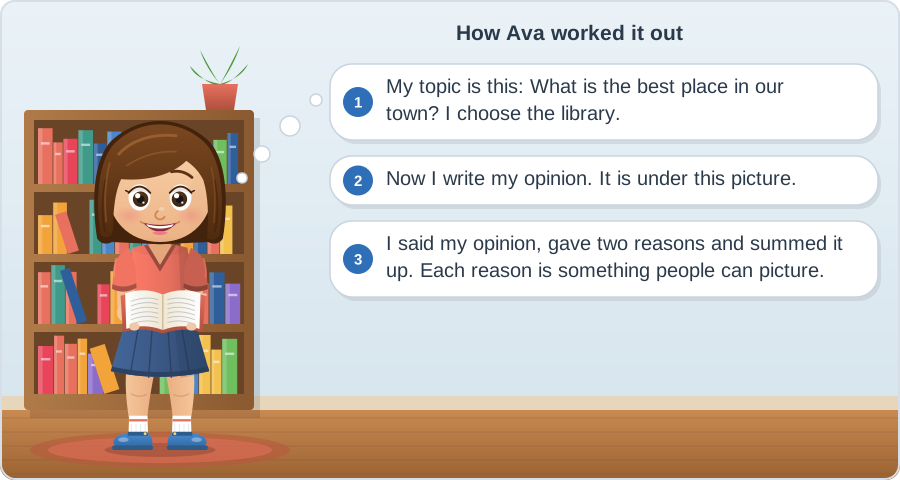
I think the library is the best place in our town because you can borrow books for free. Also, it is quiet and cool on hot days. So if you want a good afternoon, go to the library.
Now Try It
1. Is this a fact or an opinion? “The library opens at nine o’clock.”
Hint: Can you check it? Is it true for everyone?
2. Finish this opinion with a reason: “I think the park is the best place because …”
Hint: What can you do at the park?
Time To Practise
Name: ______________________
1. Fact or opinion?
Write F for fact or O for opinion.
a) Summer is the best time of year. ____
b) Our school has two playgrounds. ____
c) Pizza is the tastiest food. ____
d) Football is more fun than tennis. ____
e) The bus stop is next to the bakery. ____
f) The market is open on Saturdays. ____
2. Match the opinion to a reason.
Write the letter of the best reason.
1. I think the swimming pool is great ____
2. I think the market is fun ____
3. I think our street needs more trees ____
a) because there are lots of stalls with fruit, toys and flowers.
b) because they give shade and homes for birds.
c) because you can splash and play when it is hot.
3. Write your opinion.
Choose one topic. Write four to six sentences using the opinion frame: I think, because, also and so.
☐ What is the best place in our town? ☐ Should children help at home? ☐ Which season is best?
______________________________________________
______________________________________________
______________________________________________
______________________________________________
______________________________________________
Read your opinion to an adult. Do they agree? What is their reason?
Reflect
Think about these questions. Talk about them with someone at home or at school.
1. Go back to the Wonder question: “Why should we give a reason when we share an opinion?” What do you think now?
2. I was principled today when I ______________________________.
Being principled means being fair and honest and doing the right thing. For example: I was principled today when I listened fairly to an opinion that was different from mine.
Take action: Ask two people at home for their opinion about a place in your town. Ask them for a reason.
Next Steps
If this was easy, try: Write a second opinion that disagrees with your first one. Give two reasons for the other side.
If this was hard, go back to: Task 2. Say three opinions out loud with because, then write just two sentences: I think… because…
Notes for Parents and Teachers
Show notes for parents and teachers
These notes cover this lesson only. How every lesson runs is explained in How to Use This Material.
Let’s Learn
Point to each box in the opinion frame.
See How It’s Done
Write Ava’s opinion on paper as you go through her thoughts, so that the learner can see it.
Answer Key
Reveal Answers
Now Try It
1. Fact. You can check the opening times.
2. Sample answer: I think the park is the best place because you can play on the swings with your friends.
1. Fact or opinion?
a) O
b) F
c) O
d) O
e) F
f) F
2. Match the opinion to a reason
1. c
2. a
3. b
3. Write your opinion
Sample answer: I think children should help at home. They can help because it makes the work faster for everyone. Also, children learn to cook, tidy and look after things. I help my dad set the table every night. So all children should have a small job at home.
Look for: a clear opinion; two different reasons with because and also; a closing sentence with so; four to six sentences. Any opinion is fine if it has reasons.
Reflect
2. Any real moment from the lesson that shows the learner was principled. Examples: “I was principled today when I listened fairly to an opinion that was different from mine.” “I was principled today when I gave my honest opinion with a reason.”
For Teachers: IB Details
Show IB and curriculum details
IB theme: How we organize ourselves. It covers the communities we belong to, the jobs people do, how people work together, and how messages and ideas are shared.
Central idea: People in a community have different roles, and they share ideas and messages to help one another.
| Lesson | Title | Strand | Key concept |
|---|---|---|---|
| 9.3 | Thank You, Helper | Writing | Responsibility |
| 9.4 | I Think… Because… | Writing | Perspective |
Each lesson also matches the national curriculum for England (Year 1) and the US Common Core (Grade 1). The Grade 1 Curriculum Map lists the full standards for every lesson.
← Back to Lesson 9 – Our Community | Lessons – Index
© 2026 Firefly Ed. All rights reserved. This page may be printed for personal, home and classroom use. It may not be sold, shared online or reproduced for commercial use without written permission. edfirefly.com


Share your thoughts or ask something..