This page has the two listening and speaking lessons in Lesson 2, Home and School: Lessons 2.5 and 2.6. The Lesson 2 page has the Lesson 2 overview, the Lesson 2 review and the PDF download.
Select a lesson to go straight to it. Each lesson ends with a link back to the top of the page.
“I can listen to an instruction with two steps and do both steps in order.”
Words to know
instruction, step, then, listen
Wonder
Think about this question before you start. Say your ideas. You will come back to it at the end of the lesson.
Why is it important to listen to the whole instruction?
Let’s Learn
An instruction tells us what to do.
Some instructions have two steps. The word then tells us where the second step starts.
Listen to the whole instruction before you start. Do the first step. Then do the second step.
If you forget, you can ask: “Can you say it again, please?”
See How It’s Done
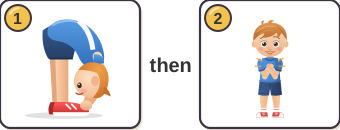
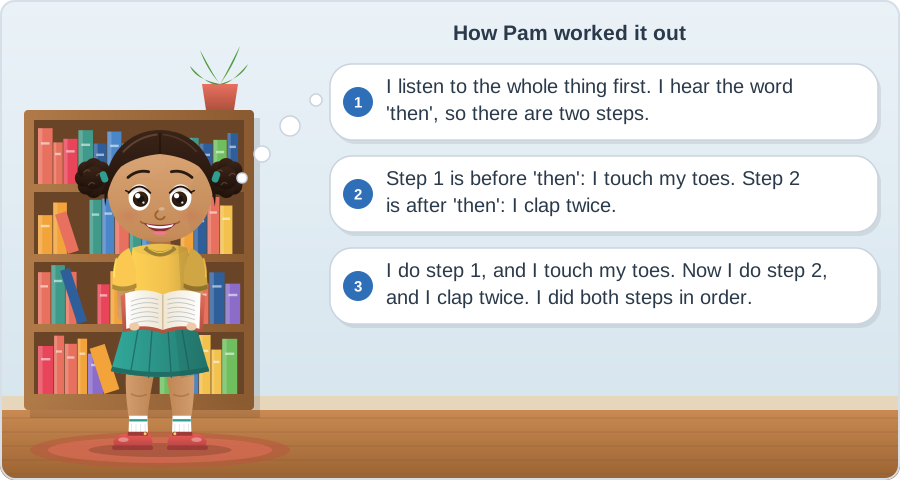
“Touch your toes, then clap twice.”
Now Try It
Listen as an adult says each instruction once. Then do it.
1. “Clap once, then touch your nose.”
Hint: Hold up one finger for each step as an adult says it.
2. “Stand up, then sit down.”
Hint: Which step comes before “then”? Do that one first.
Time To Practise
Name: ______________________
1. Listen and do.
Listen to each instruction. Do both steps, and then tick the box.
☐ a) Touch your toes, then clap twice.
☐ b) Pat your head, then hop.
☐ c) Say your name, then wave.
☐ d) Sit down, then fold your arms.
2. Listen and colour.
Listen to each instruction, and then colour.
3. Listen and draw.
Listen as an adult tells you what to draw.
Now you give an instruction with two steps to an adult. Watch them do it.
First, ______________________, then ______________________.
Reflect
Think about these questions. Talk about them with someone at home or at school.
1. Go back to the Wonder question: “Why is it important to listen to the whole instruction?” What do you think now?
2. I was principled today when I ______________________________.
Being principled means being fair and honest and doing the right thing. For example: I was principled today when I listened carefully and did both steps.
Take action: Help at home by doing a two-step job, such as “Set the table, then call everyone.”
Next Steps
If this was easy, try: Try three-step instructions, such as “Clap, then hop, then sit down.” Then give an adult one to do.
If this was hard, go back to: Now Try It. Use one-step instructions first, such as “Clap.” Add the second step only when the first is easy.
Notes for Parents and Teachers
Show notes for parents and teachers
These notes cover this lesson only. How every lesson runs is explained in How to Use This Material.
See How It’s Done
Say the instruction aloud. Then go through Pam’s thoughts and do each step together.
Now Try It
Say each instruction once. The learner does it.
Time To Practise
Task 1: Read each instruction once. The learner does both steps, then ticks the box.
Task 2: The two instructions are in the Answer Key. Read each one once. Do not point to the pictures.
Task 3: Say “Draw a big box, then draw a cat in the box.”
Answer Key
Reveal Answers
Now Try It
1. The learner claps once, then touches their nose.
2. The learner stands up, then sits down.
1. Listen and do
Look for: both steps done, in the right order, after one listen. Note any instruction where the learner did only the first step. That shows they started before the adult finished.
2. Listen and colour
a) “Colour the hat red, then colour the bag blue.” The hat is red. The bag is blue.
b) “Colour the sun yellow, then draw a line under the cup.” The sun is yellow. There is a line under the cup.
Look for: the cup is not coloured. A coloured cup means the learner mixed up “colour” and “draw a line”.
3. Listen and draw
Look for: a big box with a cat inside it. The cat should be in the box, not next to it.
Sample instruction: First, stand up, then jump.
Look for: two clear steps joined by “then”.
Reflect
2. Any real moment from the lesson that shows the learner was principled. Examples: “I was principled today when I listened carefully and did both steps.” “I was principled today when I did the steps fairly and honestly, without peeking.”
“I can describe my favourite room using three describing words.”
Words to know
describe, describing word, room, favourite
Wonder
Think about this question before you start. Say your ideas. You will come back to it at the end of the lesson.
What makes a room at home special to you?
Let’s Learn
We describe a place to help someone picture it.
A describing word tells us more about a thing. It can tell us the size, such as big or small. It can tell us the colour, such as red. It can tell us how a thing feels, such as soft or hot.
Use three describing words to tell someone about your favouriteroom.
See How It’s Done
Now Try It
Look at the picture. Answer out loud.
1. Say a word that tells the size of the kitchen.
Hint: Is it big or small? Say “The kitchen is…”
2. Say a colour word for the cupboards.
Hint: Look at the colour. Say “The cupboards are…”
Time To Practise
Name: ______________________
1. Circle the describing word.
a) I have a red rug.
b) The big bed is blue.
c) My teddy is soft.
2. Pick three describing words.
Circle three words that fit this room.
wet red sad big hot soft
Now say a sentence for each word. Start with “The sofa is…” or “The cushions are…”
3. Talk about your favourite room.
a) Draw your favourite room at home.
b) Write three describing words for your room.
Word bank: soft | big | red | small | warm | blue
1. ____________ 2. ____________ 3. ____________
c) Say three sentences about your room to an adult. Use one describing word in each. Tick each box when you have done it.
☐ I said three sentences.
☐ I used three describing words.
☐ I looked at my listener.
Reflect
Think about these questions. Talk about them with someone at home or at school.
1. Go back to the Wonder question: “What makes a room at home special to you?” What do you think now?
2. I was a communicator today when I ______________________________.
A communicator shares ideas clearly by talking, writing or drawing. For example: I was a communicator today when I used describing words to tell about my home.
Take action: Help tidy one room at home. Then describe it to a family member using three describing words.
Next Steps
If this was easy, try: Describe a room in a friend’s home or at school. Ask the listener to guess which room it is.
If this was hard, go back to: Now Try It. Use one type of describing word at a time. Start with colours, then sizes, then how things feel.
Notes for Parents and Teachers
Show notes for parents and teachers
These notes cover this lesson only. How every lesson runs is explained in How to Use This Material.
See How It’s Done
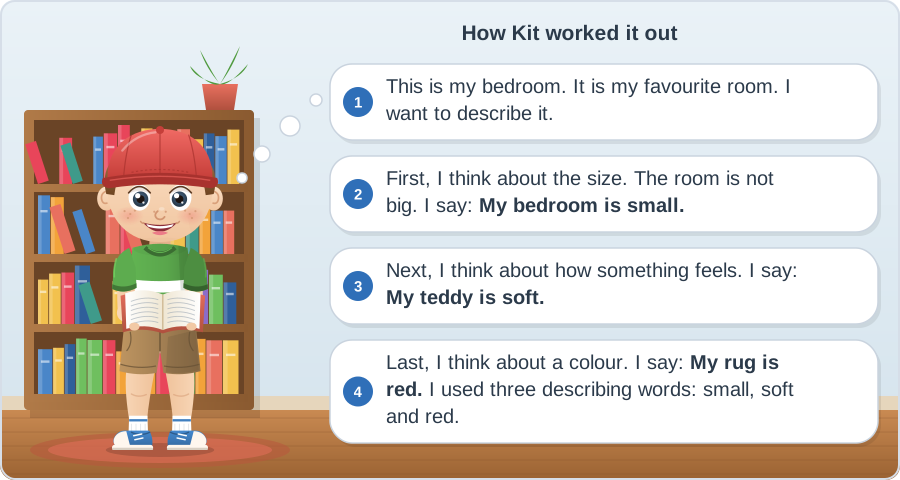
Point to each part of the picture as you go through Kit’s thoughts.
Now Try It
Point to the picture. The learner answers out loud.
Answer Key
Reveal Answers
Now Try It
1. The kitchen is big.
2. The cupboards are yellow.
Look for: a whole sentence, not one word.
1. Circle the describing word
a) red
b) big (also accept blue)
c) soft
Look for: in b), “big” and “blue” are both describing words. Accept either, or both.
2. Pick three describing words
big, red, soft
Look for: the learner says why wet, sad and hot do not fit. Sample sentences: The sofa is big. The sofa is red. The cushions are soft.
3. Talk about your favourite room
Sample answer: My bedroom is small. My bed is soft. My walls are blue.
Look for: three different describing words that match the drawing. The learner speaks clearly and looks at the listener. Accept sound-based spelling in the written words.
Reflect
2. Any real moment from the lesson that shows the learner was a communicator. Examples: “I was a communicator today when I used describing words to tell about my home.” “I was a communicator today when I spoke clearly about my favourite room.”
IB theme: How we organize ourselves. This theme is about the systems people make and how they work: how people live and work together, share jobs and make decisions.
Central idea: Homes and schools use routines, spaces and clear communication to help people live and learn together.
Each lesson also matches the national curriculum for England (Year 1) and the US Common Core (Grade 1). The Grade 1 Curriculum Map lists the full standards for every lesson.




Share your thoughts or ask something..