This page has the two reading lessons in Lesson 2, Home and School: Lessons 2.1 and 2.2. The Lesson 2 page has the Lesson 2 overview, the Lesson 2 review and the PDF download.
Select a lesson to go straight to it. Each lesson ends with a link back to the top of the page.
“I can read a short story and answer who, what, where and why questions.”
Words to know
question, who, what, where, why
Wonder
Think about this question before you start. Say your ideas. You will come back to it at the end of the lesson.
What happens when the school bell rings?
Let’s Learn
A question word tells us what kind of answer to look for.
‘Who’ asks about a person or an animal. ‘What’ asks about a thing.
‘Where’ asks about a place. ‘Why’ asks for a reason. The answer often starts with “because”.
Read the question. Then go back to the story and find the words that answer it.
See How It’s Done
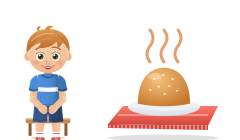
Sam sat on the mat. Sam had a hot bun.
Now Try It
Listen as an adult reads the text. Then answer each question.
Pam and Dan got in the van. The van went to school.
1. Who got in the van?
Hint: ‘Who’ asks about people. Look for names at the start.
2. Where did the van go?
Hint: ‘Where’ asks about a place. Look at the end of the story.
Time To Practise
Name: ______________________
Read with an adult.
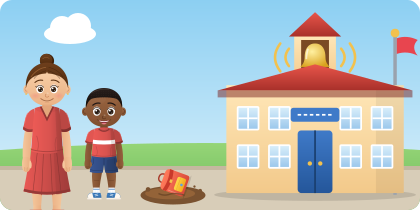
Ben and his mum went to school. Ben had his red bag. The bell rang. Ben ran in. His bag fell in the mud. Mum got it back for him.
1. Circle the answer.
a) Who went to school?
Ben and Dad Ben and his mum Pam
b) What did Ben have?
a hat a bat a red bag
2. Where and why?
a) Where did Ben and Mum go? Tick the picture.
☐ A ☐ B ☐ C
b) Why did Ben run in? Tick the answer.
☐ The bell rang.
☐ Ben was sad.
☐ Mum ran.
3. Write the answer.
What did Mum do at the end of the story?
Word bank: mud | bag | back | red
Mum got the ____________ ____________.
Reflect
Think about these questions. Talk about them with someone at home or at school.
1. Go back to the Wonder question: “What happens when the school bell rings?” What do you think now?
2. I was an inquirer today when I ______________________________.
An inquirer asks questions and finds things out. For example: I was an inquirer today when I looked back at the story to find the answer.
Take action: Ask a family member a who, a what, a where and a why question about their day.
Next Steps
If this was easy, try: Read a picture book with an adult. Ask one who, one what, one where and one why question about it. Then let the adult ask you.
If this was hard, go back to: See How It’s Done. Use only who and what questions for two days. Add where, then why, when those are easy.
Notes for Parents and Teachers
Show notes for parents and teachers
These notes cover this lesson only. How every lesson runs is explained in How to Use This Material.
Let’s Learn
Point to each question word card as you explain it.
See How It’s Done
Read the short text aloud, then go through Leo’s thoughts for each question.
Now Try It
Read the text aloud. The learner answers each question.
Answer Key
Reveal Answers
Now Try It
1. Pam and Dan
2. to school
Look for: the learner goes back to the text to find the answer rather than guessing from the picture.
1. Circle the answer
a) Ben and his mum
b) a red bag
2. Where and why?
a) C (the school)
b) The bell rang.
Look for: for b), the learner points to “The bell rang” in the story. This is the reason Ben ran in, so it answers “why”.
3. Write the answer
Mum got the bag back.
Look for: “bag” and “back” copied from the word bank in the right order. Accept “Mum got it back.” as a correct spoken answer.
Reflect
2. Any real moment from the lesson that shows the learner was an inquirer. Examples: “I was an inquirer today when I looked back at the story to find the answer.” “I was an inquirer today when I asked myself who, where and why.”
“I can read a picture timetable and say what comes before and after.”
Words to know
timetable, order, first, last, before, after
Wonder
Think about this question before you start. Say your ideas. You will come back to it at the end of the lesson.
How do we know what comes next in our day?
Let’s Learn
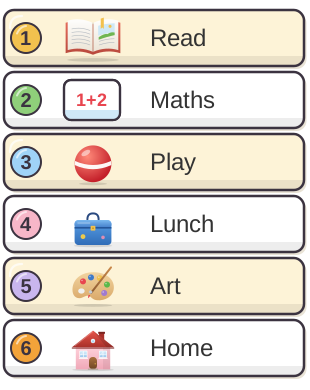
A timetable shows what happens in a day, in order.
We read it from the top to the bottom. The top is first. The bottom is last.
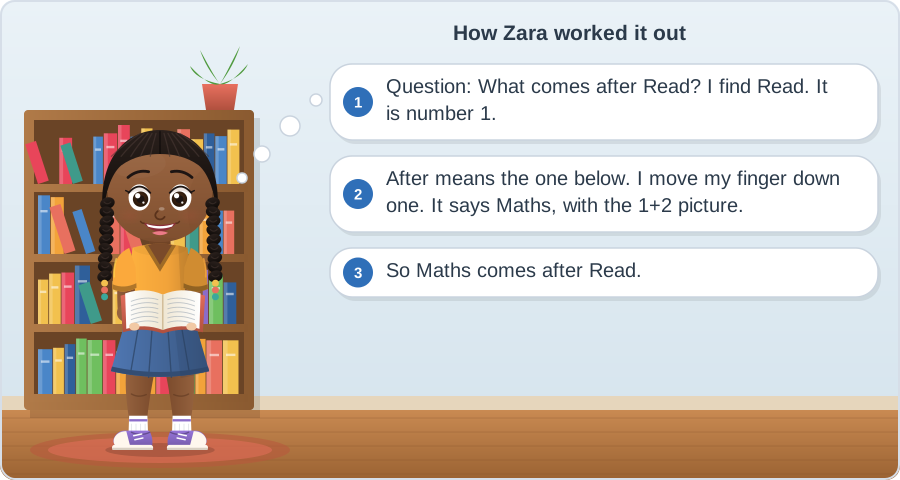
After means the one below. Before means the one above.
The pictures help us read the words.
See How It’s Done
Now Try It
Use the timetable in See How It’s Done.
1. What comes first?
Hint: First is at the top. Look at number 1.
2. What comes before Lunch?
Hint: Find Lunch. Before means the one above it.
Time To Practise
Name: ______________________
Read with an adult.
This is our day at school. First, we read. Then we do maths. Then we play. Next, it is lunch. After lunch, we do art. We like art. Last, we go home.
1. Circle the answer.
a) What comes after lunch?
Art Play Read
b) What comes last?
Read Maths Home
2. Tick yes or no.
Look at the timetable again.
Read is last. ☐ yes ☐ no
Play is after Maths. ☐ yes ☐ no
Lunch is after Play. ☐ yes ☐ no
Art is first. ☐ yes ☐ no
3. Write.
Word bank: play | home | lunch | read
a) After art, we go ______________.
b) What do you like best at school?
I like ______________________.
Reflect
Think about these questions. Talk about them with someone at home or at school.
1. Go back to the Wonder question: “How do we know what comes next in our day?” What do you think now?
2. I was balanced today when I ______________________________.
Being balanced means taking care of your body and mind, with time to work, play and rest. For example: I was balanced today when I talked about when we work, play and eat at school.
Take action: Make a picture timetable for a weekend day at home and put it on the wall.
Next Steps
If this was easy, try: Make a picture timetable for a day at home. Ask someone at home three before and after questions about it.
If this was hard, go back to: See How It’s Done. Cut the timetable into six strips and put them in order together. Ask only “What comes after…?” questions until those are easy.
Notes for Parents and Teachers
Show notes for parents and teachers
These notes cover this lesson only. How every lesson runs is explained in How to Use This Material.
Let’s Learn
Show the timetable in See How It’s Done as you explain.
See How It’s Done
Point to each row of the timetable as you go through Zara’s thoughts.
Answer Key
Reveal Answers
Now Try It
1. Read
2. Play
Look for: the learner moves a finger up for “before” and down for “after”.
1. Circle the answer
a) Art
b) Home
2. Tick yes or no
Read is last. no
Play is after Maths. yes
Lunch is after Play. yes
Art is first. no
Look for: for each “no”, the learner can say the right answer. Read is first. Home is last.
3. Write
a) After art, we go home.
b) Sample answer: I like art.
Look for: a full stop at the end of each sentence. Accept any true answer for b).
Reflect
2. Any real moment from the lesson that shows the learner was balanced. Examples: “I was balanced today when I talked about when we work, play and eat at school.” “I was balanced today when I noticed that a school day has time for work and time for play.”
IB theme: How we organize ourselves. This theme is about the systems people make and how they work: how people live and work together, share jobs and make decisions.
Central idea: Homes and schools use routines, spaces and clear communication to help people live and learn together.
Each lesson also matches the national curriculum for England (Year 1) and the US Common Core (Grade 1). The Grade 1 Curriculum Map lists the full standards for every lesson.





Share your thoughts or ask something..