
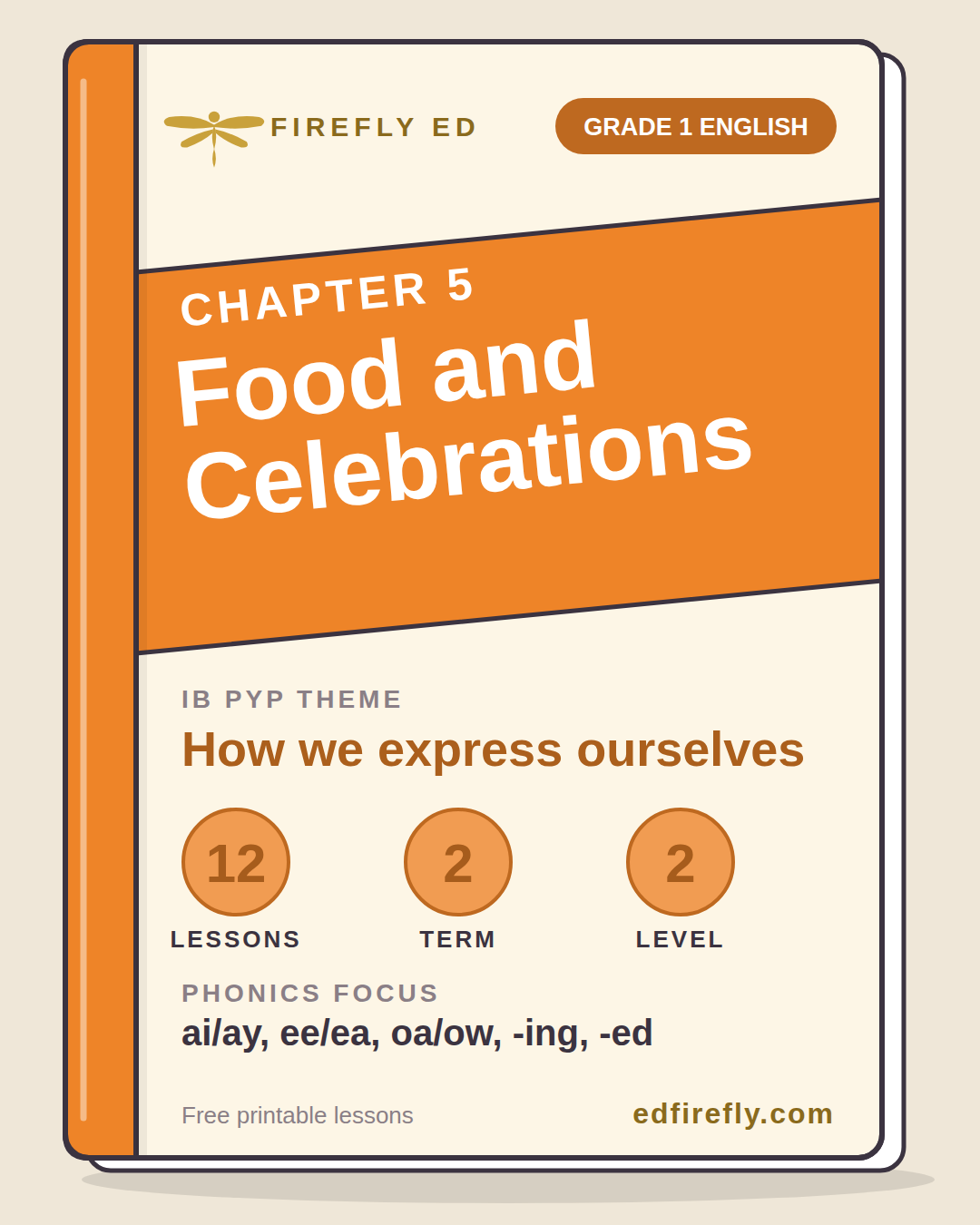
In this chapter – How we express ourselves
Term 2 | Level 2 | Phonics focus: ai/ay, ee/ea, oa/ow, -ing, -ed
Unit of inquiry
Transdisciplinary theme: How we express ourselves
In short: This theme is about how we find and share ideas, feelings, culture and beliefs: through creativity, through the different ways we communicate, and through how others respond.
Central idea: People share food and celebrations to express who they are and what they value.
Lines of inquiry
- How people celebrate special days
- How food and celebrations bring people together
- How we use words and pictures to invite, explain and share
Key concepts
- Function: How does it work?
- Connection: How is it linked to other things?
- Perspective: What are the points of view?
Related concepts: culture, tradition, purpose
Learner profile attributes
Thinkers, Knowledgeable, Caring, Reflective, Communicators, Risk-takers
Approaches to learning
Thinking skills, Self-management skills, Communication skills, Social skills
Language: Phase 1 and Phase 2 conceptual understandings
- Reading: People read to learn.
- Writing: People write to communicate.
- Writing: People write to tell about their experiences, ideas and feelings.
- Oral language: Everyone has the right to speak and be listened to.
- Visual language: Visual texts can immediately gain our attention.
Tuning in
For the adult: do this before Lesson 5.1.
Look at photos of a family celebration, or talk about one you remember. Ask: What did we eat? Who came? How did we know it was a special day? Write down the learner’s ideas and keep them.
Lessons in this chapter
| Lesson | Title | PYP strand | Line of inquiry | Key concept | Learner profile |
|---|---|---|---|---|---|
| 5.1 | What Kind of Text Is This? | Written language: receptive (reading) | 3 | Function | Thinkers |
| 5.2 | Follow a Recipe | Written language: receptive (reading) | 3 | Function | Knowledgeable |
| 5.3 | Write an Invitation | Written language: expressive (writing) | 2 | Connection | Caring |
| 5.4 | My Celebration Diary | Written language: expressive (writing) | 1 | Perspective | Reflective |
| 5.5 | Polite Requests | Oral language: expressive (speaking) | 2 | Perspective | Caring |
| 5.6 | Tell Me How to Make a Snack | Oral language: expressive (speaking) | 3 | Function | Communicators |
| 5.7 | Read a Picture Menu | Visual language: receptive (viewing) | 2 | Function | Thinkers |
| 5.8 | Design an Invitation Card | Visual language: expressive (presenting) | 1 | Perspective | Risk-takers |
| 5.9 | ai and ay | Written language: receptive and expressive (reading and spelling) | 1 | Connection | Thinkers |
| 5.10 | ee and ea | Written language: receptive and expressive (reading and spelling) | 2 | Connection | Risk-takers |
| 5.11 | oa and ow, -ing and -ed | Written language: receptive and expressive (reading and spelling) | 3 | Connection | Knowledgeable |
| 5.12 | Chapter 5 Review | All strands: receptive and expressive | All | Function, Connection and Perspective | Reflective |
How each lesson works
PYP organises language into three strands: oral language, visual language and written language. Each strand has a receptive side (understanding: listening, viewing, reading) and an expressive side (sharing: speaking, presenting, writing). Every lesson names its strand and side.
Every lesson starts with a Wonder question. The learner then moves through Let’s Learn, Watch Me, Let’s Try Together and Your Turn. Each lesson ends with Reflect, where the learner returns to the Wonder question, names a learner profile attribute they showed, and chooses an action to take.
The 12 lessons
For the adult: tap a lesson to open it. Each lesson takes about 20 minutes. Tap the lesson title again, or use the link at the end of the lesson, to close it.
Lesson 5.1: What Kind of Text Is This? | Reading | About 20 minutes
Term 2 | Level 2
Unit of inquiry: How we express ourselves | Line of inquiry: How we use words and pictures to invite, explain and share
Key concept: Function (How does it work?) | Learner profile: Thinkers | ATL skills: Thinking skills
PYP strand: Written language: receptive (reading)
I can tell whether a text tells a story, gives directions, invites or explains.
Curriculum links: IB PYP Language, Reading, Phase 2: read and understand the meaning of self-selected and teacher-selected texts at an appropriate level. Reading, Phase 2: read and understand familiar print from the immediate environment, for example, signs, advertisements, logos, ICT iconography. England Year 1: being encouraged to link what they read or hear read to their own experiences. Common Core RL.1.5: explain major differences between books that tell stories and books that give information, drawing on a wide reading of a range of text types.
Key words: purpose | story | directions | invitation | explanation
Wonder
For the adult: ask this question before you start. Accept every idea. You will come back to it in Reflect.
Why do people write in so many different ways?
Let’s Learn
For the adult: read this part aloud. Point to each card as you explain it.
Every text has a job. We call this its purpose.
A story tells what happened to characters. Directions tell us how to do something, step by step. An invitation asks someone to come to an event. An explanation tells us why or how something happens.
Clue words help. “Once upon a time” starts a story. “First” and “Next” show directions. “You are invited” starts an invitation. “Because” often shows an explanation.
Watch Me
For the adult: read each text aloud, then say the thinking aloud.
Come to my party on Friday at 4 o’clock!
“This asks someone to come to a party. It says when. It is an invitation.”
First, mix the flour and the eggs. Next, pour it into a pan.
“This tells me how to do something, step by step. I can see First and Next. It is directions.”
Let’s Try Together
For the adult: read each sentence aloud. The learner answers.
1. “Once upon a time, a mouse found a big piece of cheese.” What kind of text is this?
Hint: Look at the first four words.
2. “Leaves fall off trees in autumn because the days get cold.” What kind of text is this?
Hint: Find the word “because”. Does it tell why?
Your Turn
Name: ______________________
Read with an adult.
Text A
You are invited to Mia’s birthday party! It is on Saturday at 3 o’clock at 12 Park Road. Please come!
Text B
Rice is hard when it is dry. When we cook it in hot water, it soaks up the water. That is why cooked rice is soft.
Text C
Once upon a time, a little bear wanted to bake a cake for his mum. He put in too much flour, and the whole kitchen turned white!
Text D
How to make a jam sandwich. First, get two slices of bread. Next, spread jam on one slice. Last, put the other slice on top.
1. Match each text to its purpose.
Write the number next to each letter.
A ____ B ____ C ____ D ____
1. It gives directions. 2. It tells a story. 3. It invites. 4. It explains.
2. Find the clue words.
Write the clue words that helped you.
a) Text C is a story. The clue words are: ______________________________
b) Text D is directions. The clue words are: ______________________________
3. Which text would you use?
You are hungry and want to make your own lunch. Which text would help you? Why? Write two sentences.
______________________________________________
______________________________________________
Reflect
For the adult: talk about these with the learner.
1. Go back to the Wonder question: “Why do people write in so many different ways?” What do you think now?
2. I was a thinker today when I ______________________________.
Take action: Find three different kinds of writing at home, such as a recipe, a card and a storybook. Tell someone what each one is for.
Answer Key
Reveal Answers
Let’s Try Together
1. a story
2. an explanation
1. Match each text to its purpose
A 3, B 4, C 2, D 1
2. Find the clue words
a) Once upon a time
b) First, Next, Last (also accept “How to make”)
3. Which text would you use?
Sample answer: I would use Text D. It tells me how to make a jam sandwich, step by step.
Look for: the right text and a reason linked to its purpose. This is a simple inference: the learner connects the job of the text to their own need.
Next Steps
If this was easy, try: Collect four real texts at home, such as a card, a recipe, a storybook and a leaflet. Sort them by purpose.
If this was hard, go back to: Watch Me. Use only two kinds of text at a time, such as stories and directions, until the learner sorts them easily.
Lesson 5.2: Follow a Recipe | Reading | About 20 minutes
Term 2 | Level 2
Unit of inquiry: How we express ourselves | Line of inquiry: How we use words and pictures to invite, explain and share
Key concept: Function (How does it work?) | Learner profile: Knowledgeable | ATL skills: Self-management skills
PYP strand: Written language: receptive (reading)
I can read a recipe and put the steps in order.
Curriculum links: IB PYP Language, Reading, Phase 2: read and understand the meaning of self-selected and teacher-selected texts at an appropriate level. Reading, Phase 2 (conceptual understanding): People read to learn. England Year 1: being encouraged to link what they read or hear read to their own experiences. Common Core RI.1.3: describe the connection between two individuals, events, ideas, or pieces of information in a text.
Key words: recipe | you will need | steps | order
Wonder
For the adult: ask this question before you start. Accept every idea. You will come back to it in Reflect.
Why do the steps in a recipe need to be in order?
Let’s Learn
For the adult: read this part aloud. Point to the title, the list and the steps on the recipe card.
A recipe tells us how to make food.
It has a title, a list of what you will need, and steps that tell us what to do.
The steps must be done in order. Order words such as First, Next, Then and Last help us find the right order.
Watch Me
For the adult: say the thinking aloud and write each number as you find it.
For the adult: use the fruit salad recipe in Your Turn.
“The steps are mixed up. I look for the word First. It says: First, wash the fruit. That is step 1. I write 1 next to it.”
“Now I look for Next. Next, ask an adult to help you cut the apple and the banana. That is step 2.”
“I keep going until every step has a number. Then I read them in order to check they make sense.”
Let’s Try Together
For the adult: use the fruit salad recipe in Your Turn.
1. Name two things you need to make fruit salad.
Hint: Look under “You will need”.
2. Which step has the word Last in it?
Hint: Read each step and look for the order word.
Your Turn
Name: ______________________
Read with an adult.
Fruit Salad
You will need: 1 banana, 1 apple, a bunch of grapes, 1 spoon of honey, a big bowl, a spoon
Steps (mixed up):
____ After that, add a spoon of honey.
____ First, wash the fruit.
____ Last, mix it with a spoon and enjoy!
____ Then, put all the fruit in the big bowl.
____ Next, ask an adult to help you cut the apple and the banana.
1. What do you need?
Circle the four things you need for the fruit salad.
2. Number the steps.
Write 1, 2, 3, 4 or 5 on the line next to each step in the recipe above.
3. Think about the steps.
a) Why do we wash the fruit first? Write one sentence.
______________________________________________
b) Why should an adult help you cut the fruit? Write one sentence.
______________________________________________
Reflect
For the adult: talk about these with the learner.
1. Go back to the Wonder question: “Why do the steps in a recipe need to be in order?” What do you think now?
2. I was knowledgeable today when I ______________________________.
Take action: Make the fruit salad with an adult. Follow each step in order and share it with your family.
Answer Key
Reveal Answers
Let’s Try Together
1. Any two of: a banana, an apple, grapes, honey, a big bowl, a spoon
2. Last, mix it with a spoon and enjoy!
1. What do you need?
a (banana), c (apple), e (grapes), f (honey)
2. Number the steps
4 After that, add a spoon of honey.
1 First, wash the fruit.
5 Last, mix it with a spoon and enjoy!
3 Then, put all the fruit in the big bowl.
2 Next, ask an adult to help you cut the apple and the banana.
Look for: the learner reads the steps aloud in order to check.
3. Think about the steps
a) Sample answer: We wash the fruit to make it clean before we eat it.
b) Sample answer: A knife is sharp, so an adult should help to keep us safe.
Look for: a reason that is not written in the recipe. This is a simple inference.
Next Steps
If this was easy, try: Make the fruit salad with an adult. Then write your own recipe for a simple snack with four steps.
If this was hard, go back to: Watch Me. Cut the five steps into strips. Find the order word on each strip before putting them in order.
Lesson 5.3: Write an Invitation | Writing | About 20 minutes
Term 2 | Level 2
Unit of inquiry: How we express ourselves | Line of inquiry: How food and celebrations bring people together
Key concept: Connection (How is it linked to other things?) | Learner profile: Caring | ATL skills: Communication skills
PYP strand: Written language: expressive (writing)
I can write an invitation that tells who, what, when and where.
Curriculum links: IB PYP Language, Writing, Phase 2: write to communicate a message to a particular audience, for example, a news story, instructions, a fantasy story. England Year 1: write sentences by composing a sentence orally before writing it; using a capital letter for names of people, places, the days of the week, and the personal pronoun “I”. Common Core W.1.2: write informative/explanatory texts in which they name a topic, supply some facts about the topic, and provide some sense of closure.
Key words: invitation | who | what | when | where
Wonder
For the adult: ask this question before you start. Accept every idea. You will come back to it in Reflect.
What does a guest need to know about a party?
Let’s Learn
For the adult: read this part aloud. Point to each question card.
An invitation asks someone to come to an event, such as a party or a special meal.
A good invitation answers four questions. Who is it for? What is the event? When is it? Where is it?
It ends with who it is from, so the guest knows who invited them.
Watch Me
For the adult: write the invitation where the learner can see it. Say the thinking aloud as you write each part.
“I start with who it is for: Dear Ben.”
“Then what: my birthday party. When: Saturday at 2 o’clock. Where: 5 Hill Street.”
“I end with who it is from: From Sam. I check the four questions. Ben knows everything he needs.”
Let’s Try Together
For the adult: read the invitation aloud. The learner answers.
Dear Lily, Please come to my picnic in the park. From Jo
1. Who is the invitation for?
Hint: Look after the word “Dear”.
2. What is missing from this invitation?
Hint: Check the four questions. Does it say when?
Your Turn
Name: ______________________
1. Read the invitation.
Circle the answer.
a) Who is it for? Arjun Nina Tom
b) What is the event? a birthday party a picnic a Diwali dinner
c) When is it? Friday at 6 o’clock Sunday at 1 o’clock Monday
d) Where is it? at school 3 Green Road the park
2. Fix the invitation.
This invitation is missing two things. Write them in.
When: It is on ______________________________.
Where: It is at ______________________________.
3. Write your own invitation.
Invite someone to a celebration or a special meal. Answer all four questions.
Word bank: party | lunch | picnic | o’clock
Dear ____________________,
Please come to ______________________________.
It is on ______________________________.
It is at ______________________________.
From ____________________
Reflect
For the adult: talk about these with the learner.
1. Go back to the Wonder question: “What does a guest need to know about a party?” What do you think now?
2. I was caring today when I ______________________________.
Take action: Write a real invitation for a family meal or a play date and give it to your guest.
Answer Key
Reveal Answers
Let’s Try Together
1. Lily
2. It does not say when the picnic is.
1. Read the invitation
a) Nina
b) a Diwali dinner
c) Friday at 6 o’clock
d) 3 Green Road
Look for: in a), a learner who circles Arjun has picked the person who wrote it. Point to “Dear” and “From”.
2. Fix the invitation
Sample answer: It is on Saturday at 12 o’clock. It is at 8 Rose Lane.
Look for: a day and a time for “when”, and a place for “where”. Any sensible answer is correct.
3. Write your own invitation
Sample answer: Dear Gran, Please come to my birthday party. It is on Sunday at 3 o’clock. It is at our house. From Leo
Look for: all four questions answered, and a “Dear” and “From”. Capital letters for names and days.
Next Steps
If this was easy, try: Make an invitation for a real family event. Add a sentence that tells the guest what to bring.
If this was hard, go back to: Watch Me. Say the invitation out loud first, answering each of the four questions. Then copy the frame and fill in one line at a time.
Lesson 5.4: My Celebration Diary | Writing | About 20 minutes
Term 2 | Level 2
Unit of inquiry: How we express ourselves | Line of inquiry: How people celebrate special days
Key concept: Perspective (What are the points of view?) | Learner profile: Reflective | ATL skills: Self-management skills
PYP strand: Written language: expressive (writing)
I can write a diary entry about a special day and say how I felt and why.
Curriculum links: IB PYP Language, Writing, Phase 1: use their own experience as a stimulus when drawing and “writing”. Writing, Phase 2: read their own writing to the teacher and to classmates, realizing that what they have written remains unchanged. England Year 1: sequencing sentences to form short narratives; joining words and joining clauses using “and”. Common Core W.1.3: write narratives in which they recount two or more appropriately sequenced events, include some details regarding what happened, use temporal words to signal event order, and provide some sense of closure.
Key words: diary | date | feeling | because
Wonder
For the adult: ask this question before you start. Accept every idea. You will come back to it in Reflect.
How do you feel on a special day, and why?
Let’s Learn
For the adult: read this part aloud.
A diary is where we write about our own day. We write it for ourselves.
A diary entry starts with the date. It uses “I” and tells what happened, in order.
It also tells how we felt and why. We can use the words “I felt … because …”.
Watch Me
For the adult: read the diary entry aloud, then say the thinking aloud.
Saturday 4 May
Today was Gran’s birthday. We went to her house and ate chocolate cake. I gave her a card that I made. I felt happy because Gran smiled and gave me a big hug.
“I start with the date. Then I write what happened, in order: we went to Gran’s house, we ate cake, I gave her a card.”
“Last, I write how I felt and why. ‘I felt happy’ is the feeling. ‘because Gran smiled and gave me a big hug’ is the reason.”
Let’s Try Together
1. In the diary entry in Watch Me, what is the date?
Hint: It is at the very top.
2. Look at the picture. Finish the sentence out loud: I felt ______ because ______.
Hint: Look at the face. Then look at what happened to the balloon.
Your Turn
Name: ______________________
Read with an adult.
Sunday 12 November
Today was Diwali. In the morning, I helped Nani make sweets. At night, we lit lots of small lamps. My cousins came over and we ate a big dinner. I felt excited because the whole sky was full of lights.
1. Read the diary entry.
a) What was the special day? a birthday Diwali Eid
b) How did the writer feel? sad cross excited
c) Why did the writer feel that way? Write one sentence.
______________________________________________
2. Join the feeling to the reason.
Write the letter.
1. I felt happy ____ 2. I felt sad ____ 3. I felt excited ____
A. because my balloon popped.
B. because we were going to the fair the next day.
C. because Grandpa came to visit.
3. Write your own diary entry.
Think of a special day, such as a birthday, a festival or a family meal. Draw it. Then write about it.
Word bank: happy | excited | proud | because
Date: ____________________
Today ______________________________________________
______________________________________________
I felt ______________ because ______________________________.
Reflect
For the adult: talk about these with the learner.
1. Go back to the Wonder question: “How do you feel on a special day, and why?” What do you think now?
2. I was reflective today when I ______________________________.
Take action: Ask a family member about their favourite celebration and how it made them feel. Write one sentence about it.
Answer Key
Reveal Answers
Let’s Try Together
1. Saturday 4 May
2. Sample answer: I felt sad because my balloon popped.
1. Read the diary entry
a) Diwali
b) excited
c) The writer felt excited because the whole sky was full of lights.
2. Join the feeling to the reason
1 C, 2 A, 3 B
3. Write your own diary entry
Sample answer: Date: Saturday 3 June. Today was my birthday. We had a picnic in the park and I blew out six candles. I felt proud because I made the invitations myself.
Look for: a date, two or three sentences about what happened in order, and an “I felt … because …” sentence with a real reason. Accept sound-based spelling.
Next Steps
If this was easy, try: Keep a diary for a week. Write one entry each day with an “I felt … because …” sentence.
If this was hard, go back to: Let’s Try Together. Say your diary entry out loud first. Then write just the date and the “I felt … because …” sentence.
Lesson 5.5: Polite Requests | Oral | About 20 minutes
Term 2 | Level 2
Unit of inquiry: How we express ourselves | Line of inquiry: How food and celebrations bring people together
Key concept: Perspective (What are the points of view?) | Learner profile: Caring | ATL skills: Social skills
PYP strand: Oral language: expressive (speaking)
I can change a bossy sentence into a polite request.
Curriculum links: IB PYP Language, Oral language, Phase 2: use language to address their needs, express feelings and opinions. Oral language, Phase 1: interact effectively with peers and adults in familiar social settings. England Year 1: participate in discussions, presentations, performances, role play, improvisations and debates. Common Core SL.1.6: produce complete sentences when appropriate to task and situation.
Key words: polite | request | please | thank you
Wonder
For the adult: ask this question before you start. Accept every idea. You will come back to it in Reflect.
How do our words make other people feel?
Let’s Learn
For the adult: read this part aloud. Say the bossy bubble in a bossy voice and the polite bubble in a kind voice.
When we ask for something, we can sound bossy or polite.
A polite request uses kind words: Could I, May I, please and thank you.
We also use a calm, friendly voice and look at the person. Polite words help people feel respected and happy to help.
Watch Me
For the adult: say the thinking aloud and act out the dinner table.
“At a family dinner, I want some rice. I could say: Give me the rice. That sounds bossy.”
“I change it. I start with Could I, and I add please: Could I have the rice, please?“
“When someone passes it, I say: Thank you. I use a kind voice and look at them.”
Let’s Try Together
1. Change this to a polite request: “Pass the water.”
Hint: Start with “Could you…” and end with “please”.
2. What do you say after someone helps you?
Hint: Two words.
Your Turn
Name: ______________________
1. Tick the polite request.
a)
☐ Give me some cake.
☐ Could I have some cake, please?
☐ Cake now!
b)
☐ May I play with your ball, please?
☐ Give me your ball.
☐ Ball!
2. Make it polite.
Write each bossy sentence as a polite request.
a) “Move over.” ______________________________________________
b) “Give me the pen.” ______________________________________________
3. Party role play.
For the adult: play the host at a pretend party. The learner asks politely for each thing below. Hand it over only when the request is polite.
☐ Ask for a drink.
☐ Ask to sit next to someone.
☐ Ask for a second piece of cake.
☐ Say thank you each time.
Write one polite request you used.
______________________________________________
Reflect
For the adult: talk about these with the learner.
1. Go back to the Wonder question: “How do our words make other people feel?” What do you think now?
2. I was caring today when I ______________________________.
Take action: Use polite requests at every meal this week. Notice how people answer you.
Answer Key
Reveal Answers
Let’s Try Together
1. Could you pass the water, please?
2. Thank you.
1. Tick the polite request
a) Could I have some cake, please?
b) May I play with your ball, please?
2. Make it polite
a) Could you move over, please?
b) Could I have the pen, please?
Look for: a polite starter (Could, May or Can) and “please”. Accept “Please could I have the pen?”
3. Party role play
Sample answer: May I sit next to you, please?
Look for: a calm voice, eye contact and “thank you” after each request. The learner can also say why polite words matter.
Next Steps
If this was easy, try: Play shop at home. The shopper must make a polite request to buy each thing, and the shopkeeper says “You are welcome.”
If this was hard, go back to: Watch Me. Practise only one polite starter, “Could I have …, please?”, with real things at the table.
Lesson 5.6: Tell Me How to Make a Snack | Oral | About 20 minutes
Term 2 | Level 2
Unit of inquiry: How we express ourselves | Line of inquiry: How we use words and pictures to invite, explain and share
Key concept: Function (How does it work?) | Learner profile: Communicators | ATL skills: Communication skills
PYP strand: Oral language: expressive (speaking)
I can explain out loud how to make a snack in four steps.
Curriculum links: IB PYP Language, Oral language, Phase 2: use oral language to communicate during classroom activities, conversations and imaginative play; describe personal experiences. England Year 1: give well-structured descriptions, explanations and narratives for different purposes, including for expressing feelings. Common Core SL.1.4: describe people, places, things, and events with relevant details, expressing ideas and feelings clearly.
Key words: explain | steps | order word | doing word
Wonder
For the adult: ask this question before you start. Accept every idea. You will come back to it in Reflect.
How can we explain something so someone else can do it?
Let’s Learn
For the adult: read this part aloud.
When we explain how to make something, we give steps in order.
First, say what you need. Then give each step with an order word: First, Next, Then, Last.
Each step has a doing word, such as spread, put or cut. Speak clearly so your listener can follow you.
Watch Me
For the adult: say the steps aloud and count them on your fingers.
“I will explain how to make buttered toast. You need bread, butter and a knife.”
“First, put a slice of bread in the toaster with an adult. Next, take the toast out when it pops up. Then, spread butter on it with a knife. Last, eat it while it is warm.”
“I used four order words and a doing word in every step: put, take, spread, eat.”
Let’s Try Together
1. Say the first step for making a jam sandwich.
Hint: What do you need to get out before you spread the jam?
2. Which order word do we use for the final step?
Hint: It is the opposite of First.
Your Turn
Name: ______________________
1. Put the steps in order.
These pictures show how to make a cheese sandwich. They are mixed up.
First ____ Next ____ Then ____ Last ____
2. Circle the doing word.
a) Spread the butter on the bread.
b) Put the cheese on top.
c) Cut the sandwich in half.
3. Tell someone how to make your snack.
Pick a snack you know how to make. Plan four steps. Then say them to an adult. The adult does exactly what you say, so be clear!
Word bank: spread | put | cut | pour | mix
My snack: ____________________ You need: ______________________________
First, ______________________________________________
Next, ______________________________________________
Then, ______________________________________________
Last, ______________________________________________
☐ I said what you need.
☐ I used four order words.
☐ The adult could follow my steps.
Reflect
For the adult: talk about these with the learner.
1. Go back to the Wonder question: “How can we explain something so someone else can do it?” What do you think now?
2. I was a communicator today when I ______________________________.
Take action: Teach someone at home how to make your snack. Watch them follow your four steps.
Answer Key
Reveal Answers
Let’s Try Together
1. Sample answer: First, get two slices of bread.
2. Last
1. Put the steps in order
First B, Next A, Then D, Last C
2. Circle the doing word
a) Spread
b) Put
c) Cut
3. Tell someone how to make your snack
Sample answer: My snack is a banana smoothie. You need a banana, milk and a cup. First, peel the banana. Next, put it in the blender with an adult. Then, pour in the milk. Last, blend it and pour it into a cup.
Look for: the steps are in a sensible order, each starts with an order word and has a doing word, and they are spoken clearly. If the adult gets stuck, the learner adds the missing detail.
Next Steps
If this was easy, try: Explain how to do something without food, such as brushing your teeth or planting a seed, in five steps.
If this was hard, go back to: Watch Me. Act out each step with real bread before saying it. Say one step at a time with an order word.
Lesson 5.7: Read a Picture Menu | Visual | About 20 minutes
Term 2 | Level 2
Unit of inquiry: How we express ourselves | Line of inquiry: How food and celebrations bring people together
Key concept: Function (How does it work?) | Learner profile: Thinkers | ATL skills: Thinking skills
PYP strand: Visual language: receptive (viewing)
I can read a picture menu to choose a meal and find what it costs.
Curriculum links: IB PYP Language, Visual language, Phase 2: attend to visual information showing understanding through discussion, role play, illustrations. Visual language, Phase 1: recognize familiar signs, labels and logos; identify similarities and differences. England Year 1: being encouraged to link what they read or hear read to their own experiences. Common Core RI.1.7: use the illustrations and details in a text to describe its key ideas.
Key words: menu | picture | price | cost
Wonder
For the adult: ask this question before you start. Accept every idea. You will come back to it in Reflect.
How do pictures help us choose what to eat?
Let’s Learn
For the adult: read this part aloud. If you can, show a real menu from a cafe or a takeaway.
A menu shows the food and drinks we can choose, and what each one costs.
A picture menu uses pictures to help us read it. Each picture has a name and a price.
In our menu, the price is shown with coins. Count the coins to find the cost. To find the cost of a meal, add the coins together.
Watch Me
For the adult: point to each picture and count the coins aloud.
For the adult: use the menu in Your Turn.
“I am hungry. I look at the pictures. I choose a sandwich. I count the coins under it: 1, 2. It costs 2 coins.”
“I want a drink too. I choose juice. It costs 2 coins.”
“I add them: 2 and 2 make 4. My meal costs 4 coins.”
Let’s Try Together
For the adult: use the menu in Your Turn.
1. How much does the soup cost?
Hint: Find the soup picture. Count the coins under it.
2. Which drink costs the least?
Hint: Look at the two drinks. Which has fewer coins?
Your Turn
Name: ______________________
1. Read the menu.
Circle the answer.
a) How much does the rice cost? 2 coins 3 coins 4 coins
b) Which food costs 1 coin? Fruit Soup Rice
c) Which costs more? Juice Milk
2. Order a meal.
Choose one food and one drink. Add up the cost.
Food: ______________ costs ____ coins
Drink: ______________ costs ____ coins
My meal costs ____ coins.
3. Spend 5 coins.
You have 5 coins. Choose a meal that costs 5 coins or less. Say what you would choose and why. Then write two sentences.
______________________________________________
______________________________________________
Reflect
For the adult: talk about these with the learner.
1. Go back to the Wonder question: “How do pictures help us choose what to eat?” What do you think now?
2. I was a thinker today when I ______________________________.
Take action: Make a picture menu for a family snack time. Let everyone choose from it.
Answer Key
Reveal Answers
Let’s Try Together
1. 3 coins
2. Milk (1 coin)
1. Read the menu
a) 4 coins
b) Fruit
c) Juice
2. Order a meal
Answers will vary. Check that the cost of each item matches the menu and the total is correct. For example: Soup 3 + Milk 1 = 4 coins.
3. Spend 5 coins
Sample answer: I would choose rice and milk. That costs 5 coins, and I like rice best.
Look for: a meal that costs 5 coins or less, the correct total, and a reason. Other correct choices include soup and juice (5), sandwich and juice (4), sandwich, fruit and milk (4).
Next Steps
If this was easy, try: Look at a real menu with an adult. Choose a meal for each person in your family and find the total cost.
If this was hard, go back to: Watch Me. Choose only one item at a time and count its coins. Add a second item when counting is easy.
Lesson 5.8: Design an Invitation Card | Visual | About 20 minutes
Term 2 | Level 2
Unit of inquiry: How we express ourselves | Line of inquiry: How people celebrate special days
Key concept: Perspective (What are the points of view?) | Learner profile: Risk-takers | ATL skills: Thinking skills
PYP strand: Visual language: expressive (presenting)
I can choose colours and pictures for an invitation card and explain my choices.
Curriculum links: IB PYP Language, Visual language, Phase 1: select and incorporate colours, shapes, symbols and images into visual presentations. Visual language, Phase 2: talk about their own feelings in response to visual messages; show empathy for the way others might feel. England Key Stage 1 Art and Design: use drawing, painting and sculpture to develop and share their ideas, experiences and imagination. Common Core SL.1.5: add drawings or other visual displays to descriptions when appropriate to clarify ideas, thoughts, and feelings.
Key words: design | colour | feeling | attention
Wonder
For the adult: ask this question before you start. Accept every idea. You will come back to it in Reflect.
How can colours and pictures make someone feel excited to come?
Let’s Learn
For the adult: read this part aloud. Show a few real cards if you have them.
An invitation card should make people want to come.
Colours give a feeling. Bright colours, such as red, yellow and orange, can feel happy and exciting. Soft or dark colours can feel calm or quiet.
Pictures show what the event is about. Big, bold words help people read the most important part first.
Watch Me
For the adult: point to each card as you say the thinking aloud.
“Card A is grey. The words are small. It does not tell me what kind of party it is. It does not make me feel excited.”
“Card B has a big red title, so I read PARTY first. The balloons show it is a birthday party. The bright colours feel happy.”
“Card B grabs my attention. I would want to go to that party.”
Let’s Try Together
For the adult: use the two cards in Watch Me.
1. Which card would you pick up first? Why?
Hint: Which one catches your eye across the room?
2. What picture would suit an invitation to a Diwali party?
Hint: What do people light at Diwali?
Your Turn
Name: ______________________
1. Match the picture to the party.
Write the letter.
a) a birthday party ____ b) a Diwali party ____ c) an Eid party ____
2. Choose the colours.
You are making a card for a happy summer party. Circle three colours you would use.
grey yellow black orange brown red
Why did you choose them? Write two sentences.
______________________________________________
______________________________________________
3. Design your own invitation card.
Pick a celebration. Design the front of the card. Choose colours and pictures that fit.
Tick what your card has:
☐ a big, bold title ☐ a picture that fits the event ☐ colours that give the right feeling ☐ when and where
Tell an adult why you chose your colours.
Reflect
For the adult: talk about these with the learner.
1. Go back to the Wonder question: “How can colours and pictures make someone feel excited to come?” What do you think now?
2. I was a risk-taker today when I ______________________________.
Take action: Make a real invitation card for a celebration at home and give it to a guest.
Answer Key
Reveal Answers
Let’s Try Together
1. Sample answer: Card B, because the bright colours and big title catch my eye.
2. Sample answer: a lamp, candles or fireworks
1. Match the picture to the party
a) B (balloons)
b) C (lamp)
c) A (moon and star)
2. Choose the colours
Yellow, orange and red
Sample answer: Yellow and orange are like the sun. Bright colours make people feel happy and excited.
Look for: a reason that links colour to feeling. Accept other bright colours if the learner gives a sensible reason.
3. Design your own invitation card
Look for: a title that stands out, a picture that fits the event, and colours the learner can explain. The learner can say how they want guests to feel.
Next Steps
If this was easy, try: Make two versions of your card with different colours. Ask your family which one they like better and why.
If this was hard, go back to: Watch Me. Look at real cards or wrapping paper and sort them into “exciting” and “calm” piles.
Lesson 5.9: ai and ay | Phonics | About 20 minutes
Term 2 | Level 2
Unit of inquiry: How we express ourselves | Line of inquiry: How people celebrate special days
Key concept: Connection (How is it linked to other things?) | Learner profile: Thinkers | ATL skills: Thinking skills
PYP strand: Written language: receptive and expressive (reading and spelling)
I can read and spell words with ai and ay, and choose the right one.
Curriculum links: IB PYP Language, Reading, Phase 2: understand sound–symbol relationships and recognize familiar sounds/symbols/words of the language community. Writing, Phase 2: connect written codes with the sounds of spoken language and reflect this understanding when recording ideas. England Year 1: vowel digraphs ai and ay (the spelling appendix notes that ai is virtually never used at the end of English words, and ay is used at the end). Common Core RF.1.3c: know final -e and common vowel team conventions for representing long vowel sounds.
Key words: vowel team | ai | ay | middle | end
Wonder
For the adult: ask this question before you start. Accept every idea. You will come back to it in Reflect.
Can two different letter teams make the same sound?
Let’s Learn
For the adult: read this part aloud. Point to where each vowel team sits in its word.
Two letters can work as a team to make one vowel sound. We call them a vowel team.
ai and ay both say /ay/, like the letter name A.
Use ai in the middle of a word: rain, paint. Use ay at the end of a word: play, day.
Watch Me
For the adult: say each word slowly and point to where the /ay/ sound is.
“Rain: r-/ay/-n. The /ay/ sound is in the middle, with n after it. So I use ai: r-a-i-n.”
“Tray: t-r-/ay/. The /ay/ sound is at the very end. So I use ay: t-r-a-y.”
Let’s Try Together
1. Say “snail”. Is the /ay/ sound in the middle or at the end? Which team do you use?
Hint: Is there a sound after /ay/?
2. Say “hay”. Which team do you use?
Hint: The /ay/ is the last sound.
Your Turn
Name: ______________________
1. ai or ay?
For the adult: point to each picture and name it first: rain, snail, tray, paint, hay.
Circle the team you hear in each word.
a) ai ay b) ai ay c) ai ay d) ai ay e) ai ay
2. Sort by where the sound is.
Words: rain | day | paint | play | wait | stay | tail | tray
ai (middle): ____________ ____________ ____________ ____________
ay (end): ____________ ____________ ____________ ____________
3. Write and read.
For the adult: point to each picture and name it first: train, play, sail, day.
a) Write ai or ay.
tr ___ ___ n pl ___ ___ s ___ ___ l d ___ ___
b) Read: On Holi, we play with paint all day. Underline the ai and ay words.
c) Write your own sentence about a celebration. Use one ai or ay word.
______________________________________________
Reflect
For the adult: talk about these with the learner.
1. Go back to the Wonder question: “Can two different letter teams make the same sound?” What do you think now?
2. I was a thinker today when I ______________________________.
Take action: Make a celebration word list with ai and ay words, such as play, day, tray and paint.
Answer Key
Reveal Answers
Let’s Try Together
1. In the middle, so ai: snail
2. ay: hay
1. ai or ay?
a) ai (rain)
b) ai (snail)
c) ay (tray)
d) ai (paint)
e) ay (hay)
2. Sort by where the sound is
ai: rain, paint, wait, tail
ay: day, play, stay, tray
3. Write and read
a) train, play, sail, day
b) play, paint, day
c) Sample answer: We ate cake on my birthday.
Look for: ai in the middle and ay at the end. “birthday” ends in ay, which follows the rule.
Next Steps
If this was easy, try: Find ai and ay words in a book about a festival. Sort them into two lists.
If this was hard, go back to: Watch Me. Use only four words: rain, tail, day, play. Ask each time: Is the /ay/ in the middle or at the end?
Lesson 5.10: ee and ea | Phonics | About 20 minutes
Term 2 | Level 2
Unit of inquiry: How we express ourselves | Line of inquiry: How food and celebrations bring people together
Key concept: Connection (How is it linked to other things?) | Learner profile: Risk-takers | ATL skills: Communication skills
PYP strand: Written language: receptive and expressive (reading and spelling)
I can read and spell words with ee and ea.
Curriculum links: IB PYP Language, Reading, Phase 2: understand sound–symbol relationships and recognize familiar sounds/symbols/words of the language community. Writing, Phase 2: connect written codes with the sounds of spoken language and reflect this understanding when recording ideas. England Year 1: vowel digraphs ee and ea. Common Core RF.1.3c: know final -e and common vowel team conventions for representing long vowel sounds.
Key words: vowel team | ee | ea | long e
Wonder
For the adult: ask this question before you start. Accept every idea. You will come back to it in Reflect.
What sweet treats have the ee or ea sound?
Let’s Learn
For the adult: read this part aloud. Point to each vowel team.
ee and ea are both vowel teams. They both say /ee/, like the letter name E.
There is no easy rule for which one to use. We learn each word by looking at it closely.
Tip: if you are not sure, write the word both ways. Then pick the one that looks right, and check it in a book.
Watch Me
For the adult: write each word as you spell it, and point to the vowel team.
“Tree: t-r-/ee/. I know this word. It has a double e: t-r-e-e.”
“Sea: s-/ee/. This word uses e and a: s-e-a. It sounds the same as the letter C, but it means the big sea.”
“Same sound, different team. I look at each word carefully to remember it.”
Let’s Try Together
1. Read this word: feet. Which team makes the /ee/ sound?
Hint: Look at the middle letters.
2. Read this word: tea. Which team makes the /ee/ sound?
Hint: Look at the end of the word.
Your Turn
Name: ______________________
1. ee or ea?
Read each word. Circle the team it uses.
a) tree: ee ea b) feet: ee ea c) sea: ee ea d) tea: ee ea e) cheese: ee ea
2. Sort the party food.
Words: sweets | peas | cheese | tea | beans | seeds
ee: ____________ ____________ ____________
ea: ____________ ____________ ____________
3. Read and write.
a) Read: At the feast, we eat sweets and green peas. Underline every ee and ea word.
b) Write a party food list with three ee or ea words.
1. ____________ 2. ____________ 3. ____________
c) Write a sentence about your favourite treat. Use an ee or ea word.
______________________________________________
Reflect
For the adult: talk about these with the learner.
1. Go back to the Wonder question: “What sweet treats have the ee or ea sound?” What do you think now?
2. I was a risk-taker today when I ______________________________.
Take action: Write a party food list with ee and ea words, such as sweets, tea and peas.
Answer Key
Reveal Answers
Let’s Try Together
1. ee
2. ea
1. ee or ea?
a) ee
b) ee
c) ea
d) ea
e) ee
2. Sort the party food
ee: sweets, cheese, seeds
ea: peas, tea, beans
3. Read and write
a) feast, eat, sweets, green, peas
b) Sample answer: sweets, peas, tea
c) Sample answer: My favourite treat is a sweet peach.
Look for: words spelled with the correct team. If a learner writes “swets” or “pease”, show the word and ask them to find the team.
Next Steps
If this was easy, try: Write a menu for a party with five ee and ea foods, such as peas, beans, cheese and sweets.
If this was hard, go back to: Watch Me. Learn two ee words and two ea words at a time. Write each one three times and read it back.
Lesson 5.11: oa and ow, -ing and -ed | Phonics | About 20 minutes
Term 2 | Level 2
Unit of inquiry: How we express ourselves | Line of inquiry: How we use words and pictures to invite, explain and share
Key concept: Connection (How is it linked to other things?) | Learner profile: Knowledgeable | ATL skills: Self-management skills
PYP strand: Written language: receptive and expressive (reading and spelling)
I can read and spell words with oa and ow, and add -ing and -ed to action words.
Curriculum links: IB PYP Language, Reading, Phase 2: understand sound–symbol relationships and recognize familiar sounds/symbols/words of the language community. Writing, Phase 2: connect written codes with the sounds of spoken language and reflect this understanding when recording ideas. England Year 1: vowel digraphs oa and ow; add the endings -ing and -ed to verbs where no change is needed to the root word. Common Core RF.1.3c: know common vowel team conventions for representing long vowel sounds; L.1.4c: identify frequently occurring root words and their inflectional forms.
Key words: vowel team | oa | ow | -ing | -ed
Wonder
For the adult: ask this question before you start. Accept every idea. You will come back to it in Reflect.
How does a word change when something is happening now or already happened?
Let’s Learn
For the adult: read this part aloud. Point to each vowel team and each ending.
oa and ow are both vowel teams. They both say /oa/, like the letter name O.
oa is often in the middle of a word, as in boat and coat. ow is often at the end of a word, as in snow and grow.
We can add -ing or -ed to an action word. -ing tells us it is happening now: I am cooking. -ed tells us it already happened: I cooked.
The -ed ending can sound like /t/, /d/ or /id/, but we always spell it e-d.
Watch Me
For the adult: write each word as you say it. Point to the vowel team or the ending.
“Boat: b-/oa/-t. The sound is in the middle, so I use oa: b-o-a-t.”
“Snow: s-n-/oa/. The sound is at the end, so I use ow: s-n-o-w.”
“Now an action word: cook. Right now I am cooking. I add i-n-g. Last night I cooked. I add e-d. It sounds like /t/, but I write e-d.”
Let’s Try Together
1. Say this word: goat. Do you spell the /oa/ sound with oa or ow?
Hint: Is the sound in the middle or at the end?
2. Finish this sentence: “Yesterday I ______ the eggs.” Use the word mix.
Hint: It already happened. Which ending do we add?
Your Turn
Name: ______________________
1. oa or ow?
For the adult: point to each picture and name it first: coat, snow, boat, toast, bowl.
Write oa or ow to finish each word.
a) c ___ t b) sn ___ c) b ___ t d) t ___ st e) b ___ l
2. Now or already?
Add -ing and -ed to each cooking word.
| Word | Now (-ing) | Already (-ed) |
|---|---|---|
| cook | cooking | cooked |
| fill | ____________ | ____________ |
| toast | ____________ | ____________ |
| melt | ____________ | ____________ |
3. Cooking day
a) Circle the right word.
1. Now Mum is (mixed / mixing) the eggs in a bowl.
2. Last night we (cooked / cooking) soup.
3. Look! The cheese is (melting / melted) on the toast.
4. Yesterday Dad (toasting / toasted) the bread.
b) Write two sentences about cooking with your family. Use -ing in one and -ed in the other.
______________________________________________
______________________________________________
Reflect
For the adult: talk about these with the learner.
1. Go back to the Wonder question: “How does a word change when something is happening now or already happened?” What do you think now?
2. I was knowledgeable today when I ______________________________.
Take action: Help cook with an adult. Say what you are doing with -ing, then what you did with -ed.
Answer Key
Reveal Answers
Let’s Try Together
1. oa: g-o-a-t (the sound is in the middle)
2. mixed
1. oa or ow?
a) coat
b) snow
c) boat
d) toast
e) bowl
2. Now or already?
fill: filling, filled
toast: toasting, toasted
melt: melting, melted
3. Cooking day
a) 1. mixing 2. cooked 3. melting 4. toasted
b) Sample answer: I am mixing the eggs. Last week we toasted bread.
Look for: -ing used for now and -ed used for the past, and -ed spelled e-d even when it sounds like /t/. Note: bowl uses ow in the middle. It is one to learn by sight. Also note that ow can say /ow/ as in cow. That comes in Chapter 7.
Next Steps
If this was easy, try: Write three sentences about a snow day. Use one oa word, one ow word and one -ed word.
If this was hard, go back to: Watch Me. Practise oa and ow first with boat, coat, snow and grow. Then add -ing and -ed to one word at a time, such as cook.
Lesson 5.12: Chapter 5 Review | All strands | About 20 minutes
Term 2 | Level 2
Unit of inquiry: How we express ourselves | Line of inquiry: All three lines of inquiry
Key concept: Function, Connection and Perspective | Learner profile: Reflective | ATL skills: Self-management skills
PYP strand: All strands: receptive and expressive
I can show what I learned in Chapter 5 in reading, writing, speaking, looking and phonics.
Curriculum links: This review checks the outcomes from Lessons 5.1 to 5.11. IB PYP Language, Phases 1 and 2, across reading, writing, oral language and visual language. England Year 1: write from memory simple sentences dictated by the teacher that include words using the GPCs and common exception words taught so far. Common Core RF.1.3c, W.1.2 and SL.1.6.
Key words: recipe | invitation | polite | menu | vowel team
Wonder
For the adult: ask this question before you start. Accept every idea. You will come back to it in Reflect.
How do food and celebrations help us share who we are?
Let’s Learn
For the adult: read this part aloud. There are six short tasks. Do them in one sitting or split them over two days.
This page checks what you learned in Chapter 5.
There is one task for each part: reading, writing, oral, visual and phonics. The last task is a sentence to write after the adult says it.
Read each task with an adult. Do your best on your own first.
Watch Me
For the adult: show how the dictation in Task 6 works, using the sentence “We play in the snow.”
“You will hear a sentence. I say: We play in the snow. I say it again.”
“I count the words: We, play, in, the, snow. Five words.”
“I listen for vowel teams. Play ends with the /ai/ sound, so I use ay: p-l-a-y. Snow ends with the /oa/ sound, so I use ow: s-n-o-w.”
“I write it with a capital W and a full stop, and I read it back to check.”
Let’s Try Together
For the adult: say each word aloud. The learner answers.
1. The adult says “rain”. Is the /ai/ sound in the middle or at the end? Which team do you use?
Hint: ai is often in the middle. ay is often at the end.
2. The adult says “boat”. Which team makes the /oa/ sound?
Hint: Listen for where the sound is in the word.
Your Turn
Name: ______________________
1. Reading: What kind of text?
Read with an adult.
Cheese on Toast
You need: one slice of bread and some cheese.
Put the cheese on the toast.
Toast the bread.
Wait for it to cool, and then eat it.
Ask an adult to heat it until the cheese melts.
a) What kind of text is this? Circle one. story invitation recipe fact page
b) The steps are mixed up. Number them 1 to 4 in the right order.
____ Put the cheese on the toast.
____ Toast the bread.
____ Wait for it to cool, and then eat it.
____ Ask an adult to heat it until the cheese melts.
2. Writing: An invitation
You are having a tea party. Write an invitation to a friend. Tell who it is for, what it is, when it is and where it is.
Dear ____________________,
______________________________________________
______________________________________________
______________________________________________
From ____________________
3. Oral: Ask politely
a) Change this bossy sentence into a polite request. Say it out loud, then write it.
“Give me the cake.”
______________________________________________
b) Tell the adult how to make cheese on toast in four steps. Use first, next, then and last.
☐ I used four steps in order.
☐ I used first, next, then and last.
4. Visual: Read the menu
a) Which food costs the most? ______________
b) You buy toast and tea. How many coins do you pay? ______________
c) You have 5 coins. Choose a meal that costs 5 coins. Write what you choose and why.
______________________________________________
5. Phonics: Vowel teams and endings
For the adult: point to each picture and name it first: train, sea, coat, tray.
Part 1. Write the missing vowel team.
a) tr ___ n b) s ___ c) c ___ t d) tr ___
Part 2. Add -ing and -ed to paint. ______________ ______________
6. Write the sentence you hear
For the adult: say the sentence twice: “We had tea on the boat in the rain.”
______________________________________________
Reflect
For the adult: talk about these with the learner.
1. Go back to the Wonder question: “How do food and celebrations help us share who we are?” What do you think now?
2. I was reflective today when I ______________________________.
Take action: Plan a small celebration at home with your family. Write the invitation and help make the food.
Answer Key
Reveal Answers
Let’s Try Together
1. In the middle; ai: r-a-i-n
2. oa: b-o-a-t
1. Reading (Lessons 5.1 and 5.2)
a) recipe
b) 2 Put the cheese on the toast.
1 Toast the bread.
4 Wait for it to cool, and then eat it.
3 Ask an adult to heat it until the cheese melts.
2. Writing (Lessons 5.3 and 5.4)
Sample answer: Dear Sam, Please come to my tea party. It is on Saturday at 3 o’clock. It is at my house. We will have cake and tea. From Mia
Look for: who, what, when and where all included; a greeting and a name at the end; capital letters and full stops.
3. Oral (Lessons 5.5 and 5.6)
a) Sample answer: May I have the cake, please?
b) Sample answer: First, toast the bread. Next, put the cheese on the toast. Then ask an adult to heat it. Last, let it cool and eat it.
Look for: please or may I in part a, and four steps in order with the order words in part b.
4. Visual (Lessons 5.7 and 5.8)
a) cake
b) 3 coins
c) Sample answers: toast and soup (2 + 3 = 5); cake and tea (4 + 1 = 5). Accept any meal that adds up to 5 coins with a reason, such as “I choose cake and tea because I like sweet food.”
5. Phonics (Lessons 5.9, 5.10 and 5.11)
Part 1: a) train b) sea c) coat d) tray
Part 2: painting, painted
6. Write the sentence you hear (Lessons 5.9 to 5.11)
We had tea on the boat in the rain.
Look for: ea in tea, oa in boat and ai in rain. A capital W and a full stop.
For any task the learner missed, repeat the lesson shown in brackets before starting Chapter 6.
Next Steps
If this was easy, try: Start Chapter 6: Signs, Maps and Journeys. It begins with Lesson 6.1, Signs Around Town.
If this was hard, go back to: The lesson named next to each missed task in the answer key. Redo the Your Turn page from that lesson, then try this review again.
Taking action
By the end of this chapter, learners might:
- Plan a small family celebration: write the invitation and help make the food.
- Use polite requests at meal times.
- Make a picture menu or a recipe card to share.
Lesson 5.12 reviews the chapter. Look back at the ideas from Tuning in and talk about how they have changed.
← Previous: Chapter 4, Animals Around Us | Next: Chapter 6, Signs, Maps and Journeys →
© 2026 Firefly Ed. All rights reserved. This page may be printed for personal, home and classroom use. It may not be sold, shared online or reproduced for commercial use without written permission. edfirefly.com





Share your thoughts or ask something..