
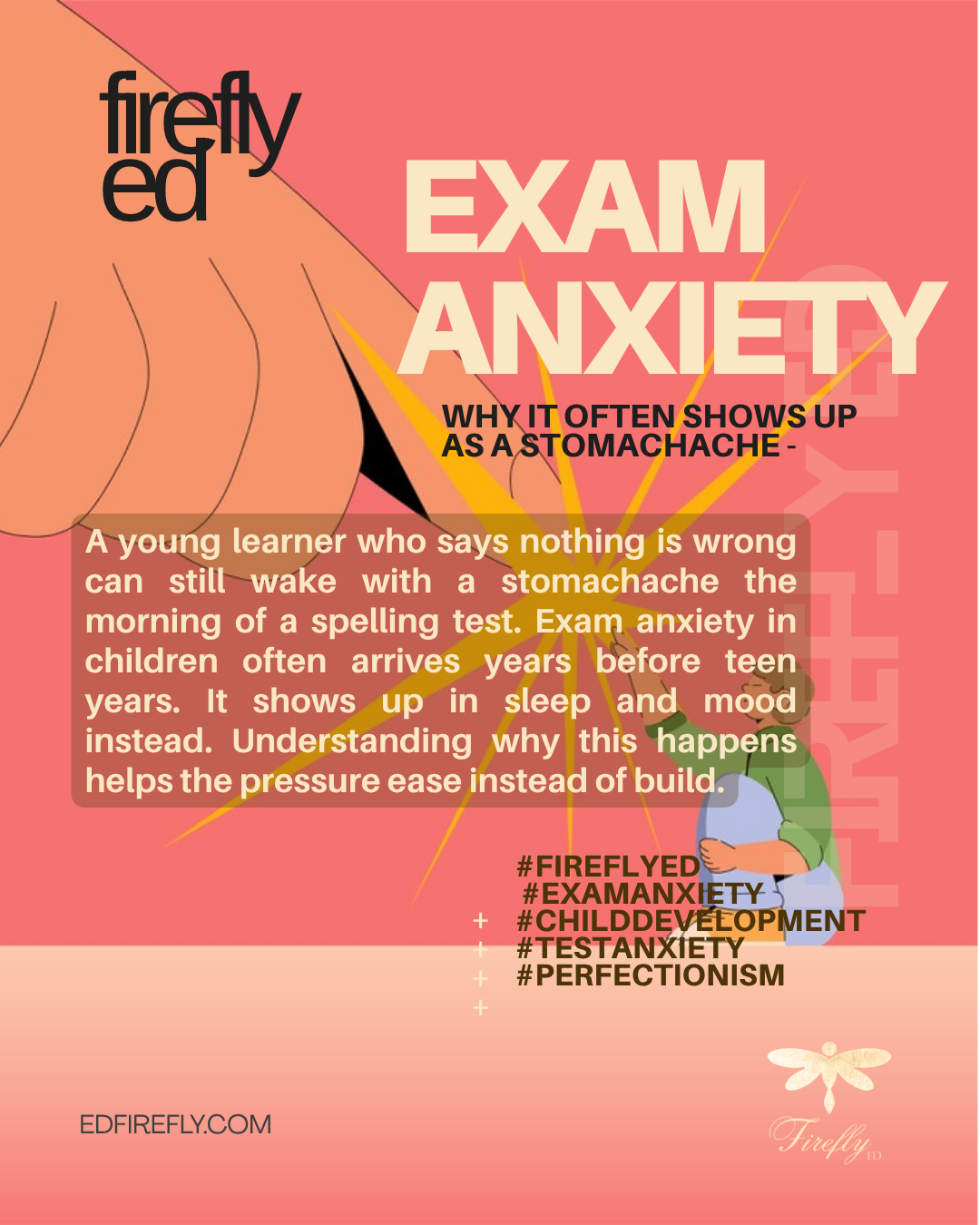
Exam Anxiety in Children Can Start Earlier Than Parents Expect
- Exam anxiety in children often shows up years before the teenage stress most people picture.
- Standardized testing often begins in third grade, the first time young learners feel measured against a bar they cannot see.
- Younger children usually show anxiety through the body first, often a stomachache or a bad night’s sleep.
- Anxiety uses up the same mental resource a learner needs to solve the test in front of them.
Exam Anxiety in Children Can Start in the Early Grades
Younger than most adults assume
Most people picture exam stress as a teenage problem: late nights before finals, a folder of revision notes. Exam anxiety in children can start much earlier. Young learners in first and second grade already show real distress around tests and quizzes.
A pattern that arrives before adults expect it
Parents and teachers often expect worry about grades to arrive around middle school, once marks start to carry weight. By the time a young learner reaches nine or ten, the pattern has often already taken hold. Catching it early matters more than catching it late.
It can look like reluctance instead of worry
The same worry can look like sudden reluctance to go to school. It can also show up as a meltdown over something small, like a shoe that won’t tie. The trigger looks unrelated, but the timing often lines up with an upcoming test.
Standardized Testing Reshapes Elementary School Around This Age
A new kind of measurement enters the picture
In the United States, federal law requires annual standardized testing in reading and math from third grade through eighth grade. For most young learners, this is the first test that compares them to a state-wide bar. Their own classroom usually runs on its own rhythm instead.
Higher stakes without a clear explanation
Teachers and schools often talk about these tests with more seriousness than a normal spelling quiz. Young learners pick up on that shift in tone quickly. They often sense it before they understand what the test measures or why it matters to adults.
Practice rounds can add pressure instead of relief
Schools often run practice rounds to prepare learners for the format. A teacher usually means this as confidence-building. For an anxious learner, it can mean more exposure to a feeling they already dread.
Ordinary Test Nerves Look Different From Anxiety That Lingers
A little nervousness is normal
Most learners feel a flutter of nerves before a test. That feeling fades once the test starts, and it clears once the test ends.
Anxiety keeps showing up after the test ends
Exam anxiety in children behaves differently. The worry can start days before the test and linger well after the answer sheet goes in. It tends to repeat with each new test instead of easing with practice.
The size of the reaction is the clue
A quiz worth a few points can trigger the same dread as a major exam. The size of the worry can outweigh what is at stake. That mismatch is often the clearest sign.
A repeating pattern says more than one bad day
One rough test morning rarely means much by itself. A pattern that repeats across most tests, month after month, tells a different story than ordinary jitters.
The Body Often Speaks Before the Words Do
Symptoms arrive before the sentence does
Anxious children report far more stomachaches and headaches than children who are not anxious. A young learner may not yet be able to say, “I feel nervous about the test.” The same learner can still wake with a sore stomach on test morning.
Emotional vocabulary builds slowly across childhood
Children build the ability to notice and name their own emotions gradually across the elementary years. A seven-year-old often has far less emotional vocabulary than a twelve-year-old. The same internal feeling can come out very differently depending on age.
Sleep and appetite often shift first
A young learner facing a stressful test week may sleep poorly or skip meals. The same learner might also seem clingy in the mornings.
None of these signs point clearly to test anxiety on their own. Together, in the days before a test, they can form a pattern parents can watch for.
Adults can misread the signal
A stomachache on test morning might be a bid to stay home, or just a bug going around the class. Reading it only as avoidance misses something else the body may be reporting. The learner may simply feel overwhelmed with no better way to say so.
Anxiety Competes With the Memory a Test Needs
Working memory holds the problem in place
Solving a math problem relies on working memory, the mental space that holds information while a learner works with it. Following multi-step instructions relies on it too. It works something like a scratchpad the brain keeps open during a task.
Anxious thoughts fill that same space
Worry takes up room in that scratchpad. A learner might replay “what if I get this wrong” during a test. That worry uses the same mental resource needed to hold numbers and steps in mind.
One study found a surprising pattern
One study followed first and second graders into math class. Anxious learners who leaned on working memory to solve problems fell nearly half a school year behind their calmer peers.
Simpler strategies protected other learners
Learners who solved problems with simpler strategies fared differently. Counting on fingers, for example, does not draw as heavily on working memory. Anxiety did not touch their performance the same way.
A capable learner can look like a struggling one
A capable learner can still freeze or make careless errors under test pressure. The material is not usually too hard for them. Anxiety is simply competing for the same mental space the problem needs.
Temperament and Perfectionism Shape How Pressure Lands
A generally anxious temperament raises the stakes further
Some children startle more easily and settle more slowly than others across most situations. That general tendency toward worry often carries directly into test day.
Test anxiety rarely travels alone in these learners
Test anxiety often shows up alongside broader anxiety and low self-esteem in the same learner. A learner already prone to worry tends to feel test pressure more sharply than a calmer peer does.
Fear of disappointing adults drives perfectionism at this age
Young learners often measure their worth by how proud an adult looks, more than older learners do. A perfect score can feel like the only way to keep that approval. Missing it can feel like letting someone down, not just getting an answer wrong.
This looks different from teenage perfectionism
A teenager’s perfectionism often centers on identity or future plans. A young learner’s version is usually simpler: staying in good standing with the adults they depend on.
How Adults Respond Shapes the Pressure a Learner Feels
Naming the feeling helps more than solving it
A learner who cannot yet say “I’m anxious” benefits from an adult offering the word. Saying “your tummy feels funny because tests can feel scary” gives the feeling a name. That happens to lots of people, and naming it beats rushing to fix it.
Reassurance works differently than adults expect
Telling a worried learner “don’t worry, you’ll be fine” can shut down the conversation rather than open it. It answers a question the learner did not ask, and skips past what they are feeling in that moment.
Calm framing beats high stakes
Describing a test as a chance to show skills, rather than a hurdle to clear, tends to lower the pressure. Learners pick up on how adults talk about a test. They notice this long before they understand what the test measures.
Routine steadies the nervous system
Keeping bedtime and the morning routine as close to normal as possible in test week helps an anxious learner. Predictability does more for a nervous body than a pep talk does.
Modeling calm carries weight
Children read an adult’s tone and body language closely, especially around anything that feels high stakes. A parent who seems tense about a test often passes that tension along, even without saying so.
Skills-based approaches show promise
A review of test anxiety treatment studies found relaxation training and cognitive behavioral approaches produced genuine improvement in school-age children. Few of those studies focused specifically on elementary-age learners. More research on this younger group would help refine what works best at each age.
What a Teacher Can Do That a Parent Cannot
A classroom runs on group rhythm, not one-on-one comfort
A parent can offer undivided attention at home. A teacher manages twenty or more learners at once and cannot give each one that same reassurance in the moment.
Predictable structure lowers anxiety before a test even starts
Explaining the test format ahead of time, in plain language, removes one layer of uncertainty. A learner who knows what a page will look like has one less unknown to worry about.
Public correction and comparison raise the temperature
Classrooms built around control and public correction show a link to higher anxiety in young learners. A quiet, private check-in does more than a comment made in front of the class.
A teacher notices patterns a parent rarely sees
A teacher watches the same learners face test after test, all year long. That view can catch a pattern a parent may not see at home. One learner might unravel every time a quiz is announced, term after term.
When to Involve a School Counselor or a Pediatrician
Most test-week jitters fade on their own
A stomachache on test morning that clears by lunchtime is common and rarely a concern. Most learners settle within a day once the test is behind them.
A pattern that spreads beyond test days is different
Anxiety that spreads beyond the test itself looks different. It can show up as avoiding school or stomachaches on ordinary days. Sleep trouble that lingers after the test is another sign.
General anxiety and low self-esteem are signals to take seriously
Test anxiety sometimes overlaps with broader anxiety or a drop in self-esteem. That combination calls for more than a calm response at home. A school counselor or pediatrician can help sort out what is driving the pattern.
A short conversation with the school is a reasonable start
Raising the pattern with a teacher or school counselor does not require a formal diagnosis first. A pediatrician can also help rule out other causes behind the stomachaches or sleep trouble.
Easing Exam Anxiety in Children Day to Day
- Name the physical feeling out loud instead of only asking whether a learner feels worried.
- Keep the days around a test as close to a normal routine as the schedule allows.
- Frame a test as a chance to show current skills rather than a verdict on ability.
- Watch for stomachaches or sleep trouble clustering around test days, beyond anything said in words.
- Practice a few slow breaths together before a test, since a calmer body frees up mental space for the material.
Firefly Ed keeps a growing library of articles for parents, teens, and young adults covering topics like this one. Readers looking to understand more about anxiety and childhood development can explore related articles in the collection.
Research Sources
Anxiety and Working Memory
Ramirez, G., Gunderson, E.A., Levine, S.C., & Beilock, S.L. (2013). Math Anxiety, Working Memory, and Math Achievement in Early Elementary School. Journal of Cognition and Development, 14(2), 187-202.
Physical Symptoms of Anxiety
Beidel, D.C., Christ, M.G., & Long, P.J. (1991). Somatic Complaints in Anxious Children. Journal of Abnormal Child Psychology, 19(6), 659-670.
Emotional Vocabulary in Childhood
Rieffe, C., Meerum Terwogt, M., Petrides, K.V., Cowan, R., Miers, A.C., & Tolland, A. (2007). Psychometric Properties of the Emotion Awareness Questionnaire for Children. Personality and Individual Differences, 43(1), 95-105.
What Helps Reduce Test Anxiety
Von der Embse, N., Barterian, J., & Segool, N. (2013). Test Anxiety Interventions for Children and Adolescents: A Systematic Review of Treatment Studies from 2000-2010. Psychology in the Schools, 50(1), 57-71.
Test Anxiety and General Anxiety
Robson, D.A., Johnstone, S.J., Putwain, D.W., & Howard, S. (2023). Test Anxiety in Primary School Children: A 20-Year Systematic Review and Meta-Analysis. Journal of School Psychology, 98, 39-60.
Classroom Management and Anxiety
Manley, H., Tu, E-N., Reardon, T., & Creswell, C. (2023). The Relationship Between Teachers’ Day-to-Day Classroom Management Practices and Anxiety in Primary School Children: A Systematic Review. Review of Education, 11(1), e3385.




Share your thoughts or ask something..