
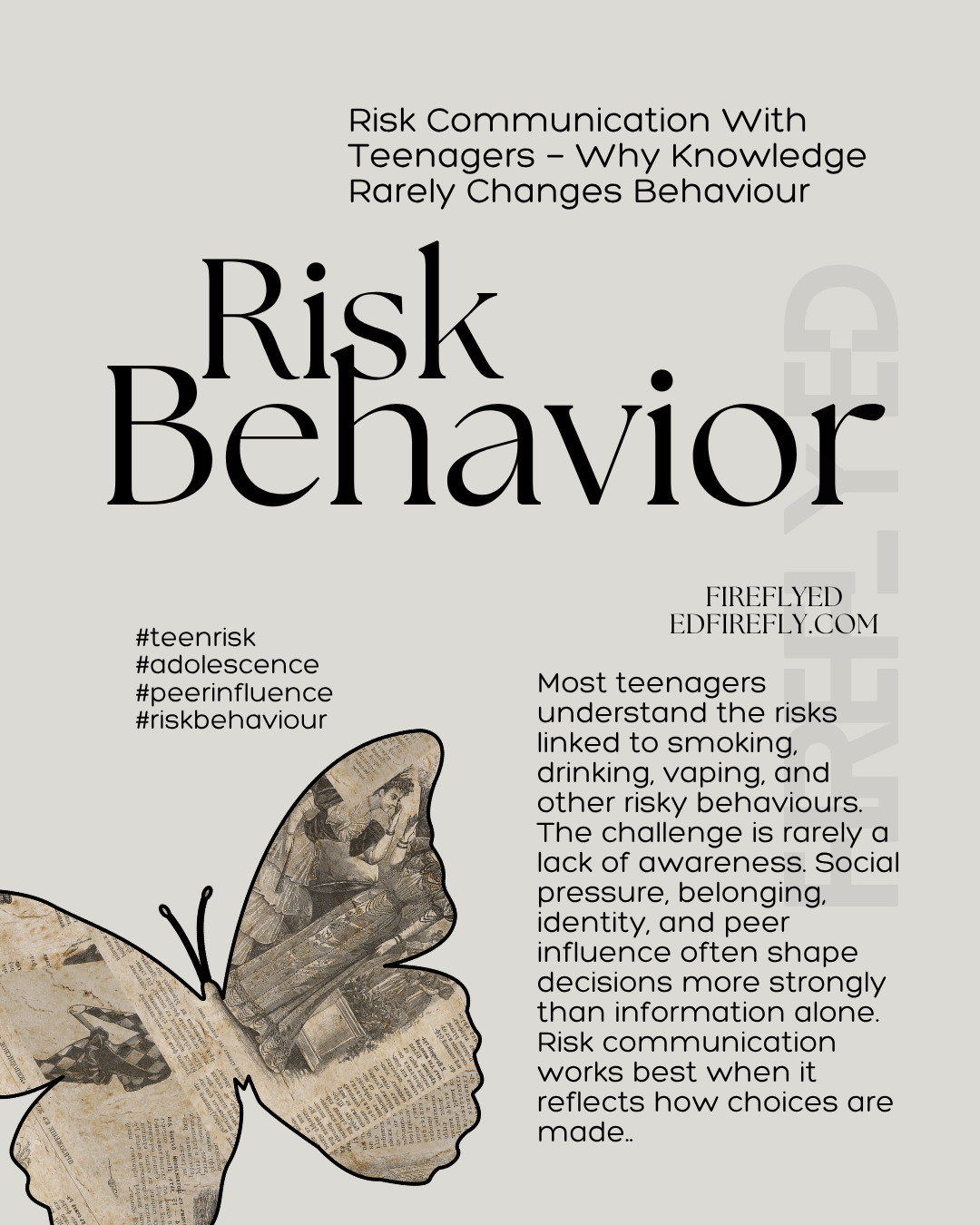
Why Teenagers Often Ignore Risks They Understand
- Most teenagers already understand many common risks.
- Knowledge rarely drives behaviour on its own.
- Social rewards often compete with future consequences.
- Identity shapes many adolescent decisions.
- Peer influence can encourage positive or negative behaviour.
- Risk communication works best when it reflects real life.
Most adults assume better information leads to better decisions. The idea seems straightforward. If teenagers understand the dangers linked to smoking, drinking, vaping, or reckless driving, safer choices should follow.
Life rarely works that way. Most teenagers already know these activities carry risks. They hear about them at school, online, and at home. Knowledge matters, but it forms only one part of a much larger picture.
Risk communication with teenagers becomes more effective when it reflects how decisions happen in everyday life. Social pressure, belonging, identity, and peer influence often shape behaviour alongside knowledge.
Why Information Alone Does Not Change Behaviour
Knowing and doing differ
Most people experience a gap between knowledge and behaviour. Adults know exercise improves health. Many still skip workouts. Adults understand the value of sleep. Many stay awake later than intended.
Teenagers experience the same pattern. Understanding a risk does not guarantee a particular choice. Knowledge helps people evaluate options. It does not automatically determine behaviour.
Decisions happen in context
Risk information often arrives in calm settings. A teacher explains it during a lesson. A parent raises it during a conversation. A poster lists possible consequences.
The decision itself usually happens elsewhere. Friends may be present. Emotions may run high. Someone may want to fit in or avoid standing out. The setting changes how information is weighed.
A teenager who understands a risk perfectly in a classroom may respond differently with friends. The information remains unchanged. The situation does not.
Immediate rewards matter
Many risky choices involve an immediate reward and a future consequence. Immediate rewards often feel stronger because they exist in the present.
Approval from friends arrives straight away. Acceptance within a group feels immediate. Consequences may seem distant even when they are understood clearly.
The Adolescent Brain and Risk
Belonging carries weight
Adolescence is a period when friendships become especially important. Teenagers spend more time with peers and gradually build independence from family.
Belonging carries emotional value. Acceptance feels rewarding. Exclusion feels uncomfortable. Decisions often reflect these social realities.
Social rewards compete
Teenagers often weigh social outcomes alongside physical risks. A behaviour may carry clear dangers. It may also offer inclusion, status, or approval.
Several priorities can operate at once. A teenager may understand the risk completely while still focusing on the social outcome available in the moment.
Awareness is common
Many adults assume teenagers take risks because they believe nothing bad will happen. Most teenagers understand harmful outcomes remain possible.
They know accidents happen. They know substances can cause harm. Awareness alone rarely removes the social pressures surrounding a decision.
Why Risk Behaviour Often Looks Different From The Outside
Adults see the outcome
Adults often judge behaviour by its result. A teenager smoked, drank, or took a dangerous risk. From the outside, the decision can appear simple.
The teenager experiences something different. The situation includes friendships, emotions, expectations, and uncertainty. Those factors may feel more important than adults realise.
Belonging changes decisions
Many teenagers fear social exclusion more than adults expect. Friendship groups provide support, identity, and connection.
When a risky behaviour appears linked to belonging, the decision becomes more complicated. The teenager may weigh social consequences alongside physical ones.
Risk can carry meaning
Some behaviours communicate membership within a group. Others signal independence or maturity. Teenagers may attach social meaning to behaviour that adults view only through the lens of safety.
Understanding this broader picture creates a more realistic view of adolescent decision-making.
Why Adults Keep Returning To Information
Information feels logical
Adults often respond to risky behaviour by providing more information. The approach feels reasonable because information remains important.
People need accurate facts before making informed decisions. Good communication always includes clear information.
Knowledge has limits
Problems arise when information becomes the only strategy. Behaviour develops through knowledge, habits, relationships, and identity.
A teenager may understand every consequence linked to a behaviour and still struggle to resist social pressure. More facts may not change the situation.
Relevance increases impact
Teenagers engage more deeply when information connects with everyday experiences. Generic warnings often feel distant.
Examples that reflect real situations feel easier to understand and apply.
Why Peer Influence Is So Powerful
Friends shape behaviour
People often look to others when deciding how to behave. Teenagers do this frequently because friendships play a central role during adolescence.
Peer influence affects clothing, language, hobbies, and behaviour. Risk-taking forms part of the same process.
Influence differs from pressure
Peer pressure suggests direct encouragement. Peer influence often happens quietly.
A teenager may change behaviour simply because something appears normal within a group. Nobody needs to make a direct suggestion.
Positive influence exists
Peer influence receives attention when it leads to risky behaviour. It can also encourage healthy choices.
Friends can promote academic effort, sport, volunteering, and responsible decision-making. Positive influence deserves equal attention.
Identity Shapes Behaviour
Identity develops quickly
Adolescence involves a growing sense of identity. Teenagers begin deciding what matters to them and how they want others to see them.
Choices often become connected to self-image. Behaviour can communicate values and group membership.
Identity supports consistency
People tend to act in ways that fit their view of themselves. Behaviour becomes easier to maintain when it matches identity.
A teenager who sees themselves as responsible may avoid behaviour that conflicts with that image. Identity provides motivation beyond simple rule-following.
Values guide choices
Messages connected to personal values often remain memorable. Teenagers frequently respond when behaviour links to the kind of person they want to become.
This approach reaches beyond consequences and focuses on self-understanding.
Teenagers Often Misjudge Social Norms
Visible behaviour attracts attention
Risky behaviour often attracts attention because it feels memorable. Dramatic stories travel further than ordinary ones.
A teenager may hear about a party where several people drank alcohol. The larger number who chose not to drink may receive little attention.
Social media magnifies visibility
Social media can make unusual behaviour appear common. People tend to share exciting experiences rather than ordinary decisions.
A small number of visible examples can create the impression that everyone behaves the same way.
Perceptions become distorted
Over time, teenagers can develop an inaccurate picture of peer behaviour. Risk-taking may appear far more common than it truly is.
These assumptions influence decisions. People often adjust behaviour to match what they believe others are doing.
Correcting assumptions helps
Many prevention programmes focus on correcting inaccurate beliefs. Teenagers often feel less pressure when they learn a behaviour is less common than expected.
The approach works because it changes perceptions of what is normal within a group.
What Makes Risk Communication More Effective
Conversations work better
Teenagers often respond more positively to discussion than lectures. Conversations create room for questions and reflection.
They also acknowledge growing independence. Teenagers engage more when they feel involved in the process.
Peer-led approaches help
Older teenagers can sometimes communicate messages more effectively than adults. They understand the situations younger teenagers face.
Their experiences often feel relevant and credible.
Consistency matters
One conversation rarely changes behaviour. Consistent messages across home, school, and friendship groups create a stronger effect.
Repeated exposure helps ideas become familiar and easier to apply.
Relationships influence choices
Strong relationships create opportunities for meaningful conversations. Teenagers listen more closely to people they trust.
Trust does not remove risk-taking. It can create space for reflection before decisions happen.
Why Knowledge Still Matters
Information remains essential
None of this means information lacks value. Teenagers still need accurate facts about risks and consequences.
Knowledge provides a foundation for decision-making. People cannot weigh options properly without understanding them.
Knowledge supports judgement
Information becomes most useful when teenagers connect it with personal experience. Facts support reflection. Reflection supports judgement.
The strongest approaches combine information with opportunities to think about realistic situations.
Multiple influences operate together
Behaviour rarely changes for a single reason. Knowledge matters. Relationships matter. Identity matters too.
Risk communication becomes more effective when it reflects this wider picture.
Firefly Ed supports adolescent development
Firefly Ed works with young people aged 3 to 14, supporting academic, social, and emotional development. The teen wellbeing series explores the experiences that shape adolescence, including the factors that influence risk-related decisions.
Research Sources
Risk Communication and Adolescent Behaviour
Reyna, V. F., & Farley, F. (2006). Risk and Rationality in Adolescent Decision Making. Psychological Science in the Public Interest, 7(1), 1–44.
Social Context and Adolescent Risk
Steinberg, L. (2008). A Social Neuroscience Perspective on Adolescent Risk-Taking. Developmental Review, 28(1), 78–106.
Social Norms Approaches to Risk Reduction
Perkins, H. W. (2003). The Social Norms Approach to Preventing School and College Age Substance Abuse. San Francisco: Jossey-Bass.


Share your thoughts or ask something..