
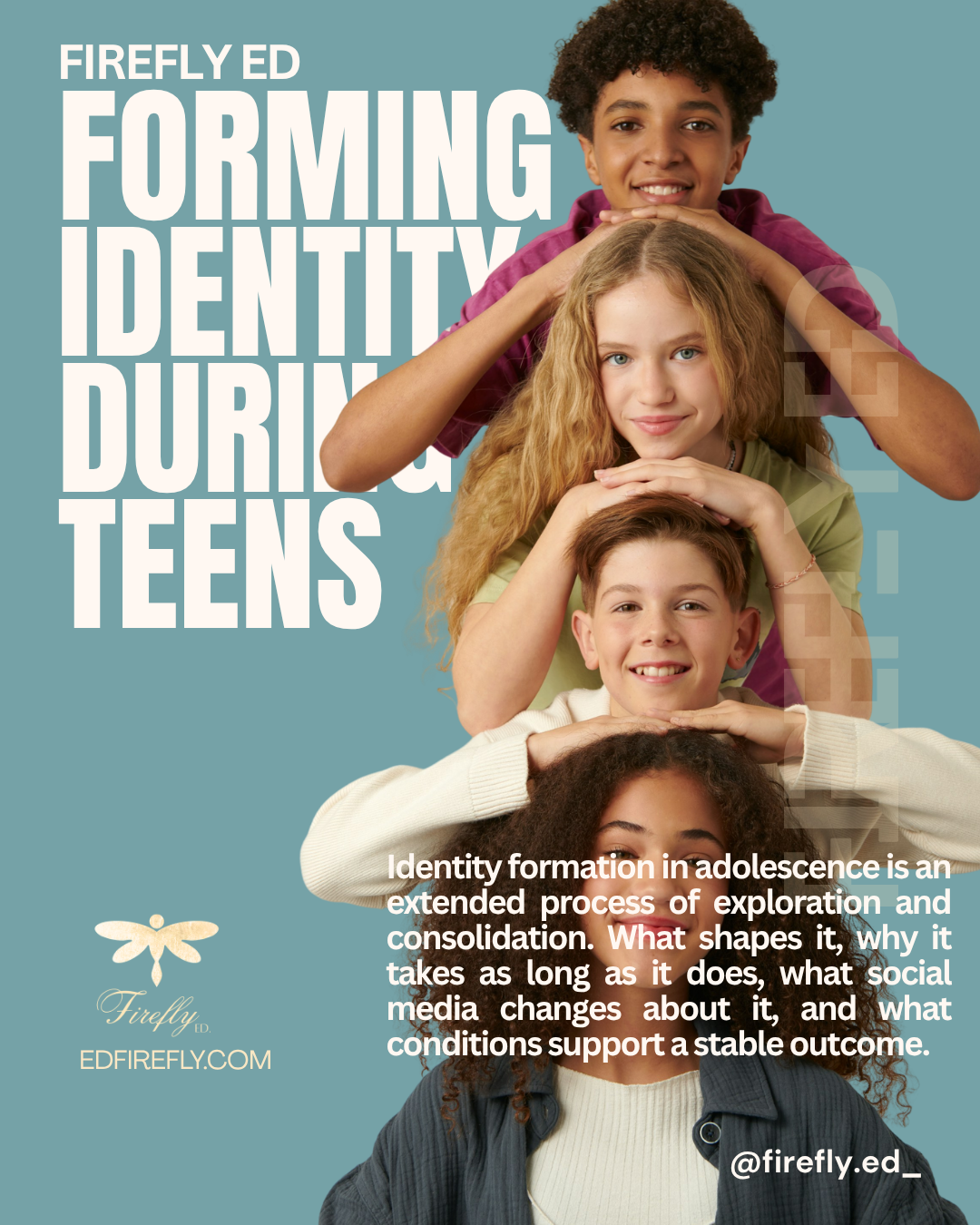
Identity Formation in Adolescence — A Gradual and Non-Linear Process
- Identity formation in adolescence is the central developmental task of the teenage years.
- It proceeds through exploration and commitment, not in a single step.
- Identity forms in relation to others and to experience — not in isolation.
- Social media has become a significant new context for identity exploration, with both useful and complicating effects.
- Adolescents may hold different identities in different contexts before a stable sense of self consolidates.
- The process continues into early adulthood and does not complete at eighteen.
What Identity Formation Involves
Identity answers the question of self
Identity is the answer a person gives, consciously or not, to the question of who they are. It encompasses values, beliefs, interests, roles, and a sense of continuity across time and context. In adolescence, the work of forming that answer moves to the foreground.
Identity versus role confusion is central
Adolescence is the developmental stage defined by the tension between identity and role confusion. Teenagers who navigate it well arrive at a coherent sense of self, stable enough to provide direction. Those who do not may experience prolonged uncertainty about who they are and where they belong.
Four statuses map the identity process
Identity statuses fall along two dimensions: exploration and commitment. Moratorium involves active exploration without commitment. Foreclosure involves commitment without exploration, often adopting an identity handed down by family. Achievement involves both. Diffusion involves neither.
Why the Process Takes as Long as It Does
Identity formation requires lived experience
Identity formation takes time because it requires experience. A teenager cannot know what they value until they have encountered situations that test their values. They cannot know what interests them until they have had sufficient exposure to form genuine preferences.
The prefrontal cortex develops alongside experience
The prefrontal cortex supports the reflective thinking that identity consolidation requires. It continues maturing throughout adolescence and into the mid-twenties. The neurological infrastructure for sustained self-reflection develops alongside the life experience that gives it material to work with.
Inconsistency is the process working correctly
This is why identity formation is non-linear. Teenagers try on different versions of themselves — in friend groups, in interests, in presentation, in values — and revise as they go. What looks like inconsistency from the outside is often the process working as it should.
Social Media and Identity Exploration
Social media is an identity context
Social media now functions as a significant context for identity exploration. Adolescents use digital environments to present versions of themselves, receive feedback from peers, observe others, and test how different self-presentations land. This is broadly consistent with how identity development has always worked — through interaction and response.
Active use supports identity exploration more
The relationship between social media and identity development depends on how teenagers engage with it. Active participation — creating content, interacting, expressing genuine views — associates with greater identity exploration. Passive consumption — scrolling without engaging — associates with lower self-concept clarity and disengagement from exploration.
Time spent on social media matters less than what the teenager does while there.
Authenticity online correlates with clearer self-concept
Teenagers who present themselves authentically on social media tend to report clearer self-concept than those who present an idealised version of themselves. Performing a self misaligned with actual experience produces a gap between public and private self. That gap complicates identity work rather than supporting it.
Social comparison raises identity distress
Adolescents who engage in frequent social comparison on social media show higher levels of identity distress alongside higher identity exploration. Comparison can prompt identity-relevant questions — who am I relative to others? — but the answers it generates are often more destabilising than clarifying.
Cultural and Ethnic Identity
Cultural identity is a separate task
For teenagers from minority ethnic or cultural backgrounds, identity formation includes an additional dimension: the development of a cultural or ethnic identity. This involves understanding one’s heritage and navigating between different cultural contexts.
It also means forming a view of oneself within a broader social landscape that may not affirm that heritage.
Strong ethnic identity supports overall wellbeing
A well-developed ethnic identity connects with positive wellbeing outcomes. Teenagers with a clear and affirmed sense of their cultural background report higher self-esteem, greater resilience to discrimination, and stronger academic motivation. Cultural identity is not separate from personal identity. For many teenagers, it is central to it.
Social media supports minority identity development
For teenagers from minority backgrounds, digital environments offer access to communities, representations, and narratives that may be absent from their immediate surroundings. Online spaces provide cultural mirroring that supports positive ethnic identity development. This matters when the local environment does not offer it.
Multiple Identities Across Contexts
Varying across settings is developmentally normal
It is common for teenagers to present differently in different settings. A teenager might be more reserved at school, more open with close friends, and different again within the family. Different relationships bring out different aspects of a developing self. This is not deception. It is exploration.
No safe context signals deeper concern
Concern arises when the gap between public and private selves becomes very large. A teenager who feels unable to be themselves in any context needs closer attention.
The Role of Relationships and Environment
Identity forms in relation to others
Teenagers construct their sense of self largely through feedback, comparison, and the experience of being recognised and responded to. They cannot fully know how they want to relate to others until relationships reveal something back to them.
Premature commitment interrupts exploration
Environments that demand premature commitment interrupt the exploration that genuine identity formation requires. A teenager pushed too early toward a settled identity often revisits it with disruption in early adulthood.
Safe relationships support honest identity development
Relationships where a teenager can express genuine opinions and make mistakes without performance pressure contribute most to healthy identity development. Safety is not the same as absence of challenge. It is the confidence that the relationship can hold honest expression.
Firefly Ed works with teenagers through discussion-based learning that creates space for genuine thinking and honest expression. The approach supports the kind of intellectual engagement that underpins a developing sense of self.
Research Sources
Identity Development in Adolescence
Erikson, E.H. (1968). Identity: Youth and Crisis. Norton.
Marcia, J.E. (1966). Development and validation of ego-identity status. Journal of Personality and Social Psychology, 3(5), 551–558.
Adolescent Self-Concept
Harter, S. (1999). The Construction of the Self: A Developmental Perspective. Guilford Press.
Social Media and Adolescent Identity
Avci, H., Baams, L. & Kretschmer, T. (2025). A systematic review of social media use and adolescent identity development. Adolescent Research Review, 10(2), 219–236.
Adolescence and Development
Steinberg, L. (2014). Age of Opportunity: Lessons from the New Science of Adolescence. Houghton Mifflin Harcourt.


Share your thoughts or ask something..