
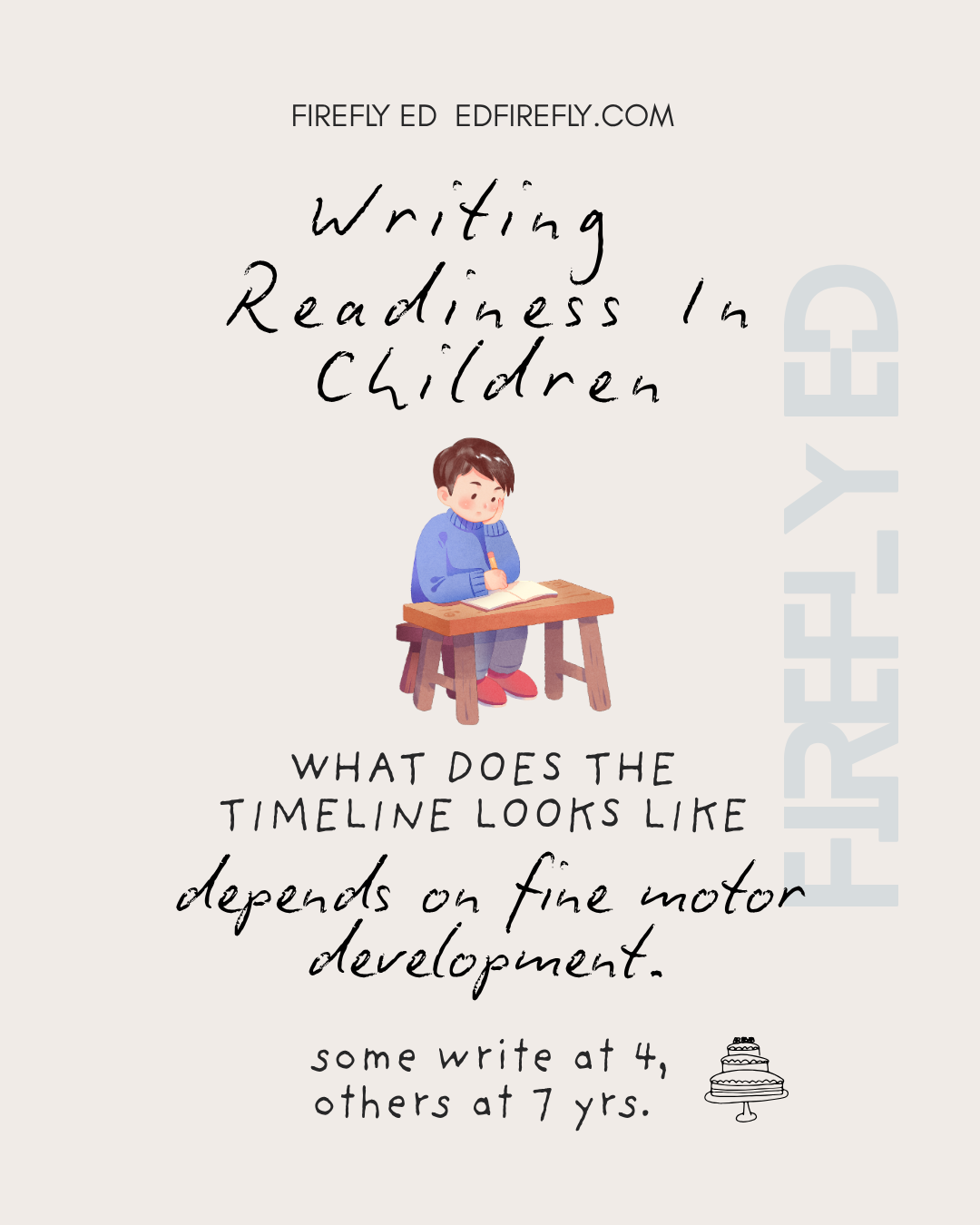
Writing Readiness in Children
- Writing depends on fine motor control and symbolic understanding — both develop at different rates.
- At age 4, many children are still building the hand strength needed to hold a pencil properly.
- Activities like tearing paper and playing with clay build writing readiness without a pencil.
- Some children start writing at 4, some closer to 6 or 7 — both are within the normal range.
- Pushing writing before hands are ready can create frustration and resistance that persists.
When Writing Does Not Look Like Writing Yet
Other children in the class are writing their names. Some are forming full sentences. Meanwhile, another student is still scribbling — happily, but noticeably differently from the rest.
It is a common point of concern. Writing readiness is not a single skill. It is several skills working together, arriving at different times.
What Writing Requires
To form letters on a page, children need fine motor control: the ability to grip and guide a pencil with precision. They also need hand-eye coordination and the cognitive understanding that symbols on a page carry meaning.
At age 4, many children are still developing the hand strength to hold a pencil properly. That is development running on its own schedule — not a delay.
What Happens When Writing Is Pushed Too Early
Asking children to write before their hands are physically ready can lead to awkward grip habits that are difficult to correct later. It can also create frustration — and frustration at this stage often turns into resistance toward writing altogether.
The association formed is not with communication or expression. It is with something that is hard and uncomfortable. That association can persist well beyond the early years.
What Builds Readiness
The activities that prepare young learners for writing do not involve a pencil at all. Tearing paper, threading beads, playing with clay, scribbling, painting, building with blocks, using tongs and tweezers — all of these strengthen the small muscles in the hands and fingers that writing depends on.
Drawing is especially useful. Children who draw freely are practising control and the connection between intention and movement — both of which transfer directly to letter formation when the time comes.
The Timeline
Some children start writing at 4. Some are closer to 6 or 7. Both are within the normal developmental range. Neither early nor late writing is a reliable indicator of ability or delay. Development has its own timeline, and pushing ahead of it does not accelerate the process. It adds pressure to something that works better without it.
What Helps in the Meantime
Filling the environment with letters — books, signs, labels, magnetic letters — builds familiarity without pressure. Seeing adults write normalises it as an everyday activity.
Where there is interest in writing, that interest should be followed. Where there is not, the focus is better placed on the foundation — hand strength, coordination, comfort with tools. The writing follows when the readiness is there. Young learners who love stories and explore with their hands are already on the path.
Firefly Ed offers private academic classes for children aged 3–14, shaped around developmental readiness and the way children naturally build skills. More at edfirefly.com.
Research Sources
Writing Readiness and Fine Motor Development
Flatters, I. et al. (2014). The Relationship Between Gross Motor Skills and Fine Motor Skills in Children. Journal of Motor Behavior, 46(3).
Dinehart, L. & Manfra, L. (2013). Associations Between Low-Income Children’s Fine Motor Skills and Academic Performance. Early Education and Development, 24(2).
Early Writing and Developmental Readiness
Berninger, V.W. et al. (2006). Early Development of Language by Hand. Developmental Neuropsychology, 29(1).
Pre-Writing Activities and Hand Strength
Fajariani, D. et al. (2025). Analyzing Occupational Performance of Children With Handwriting Difficulties. Occupational Therapy International.


Share your thoughts or ask something..