
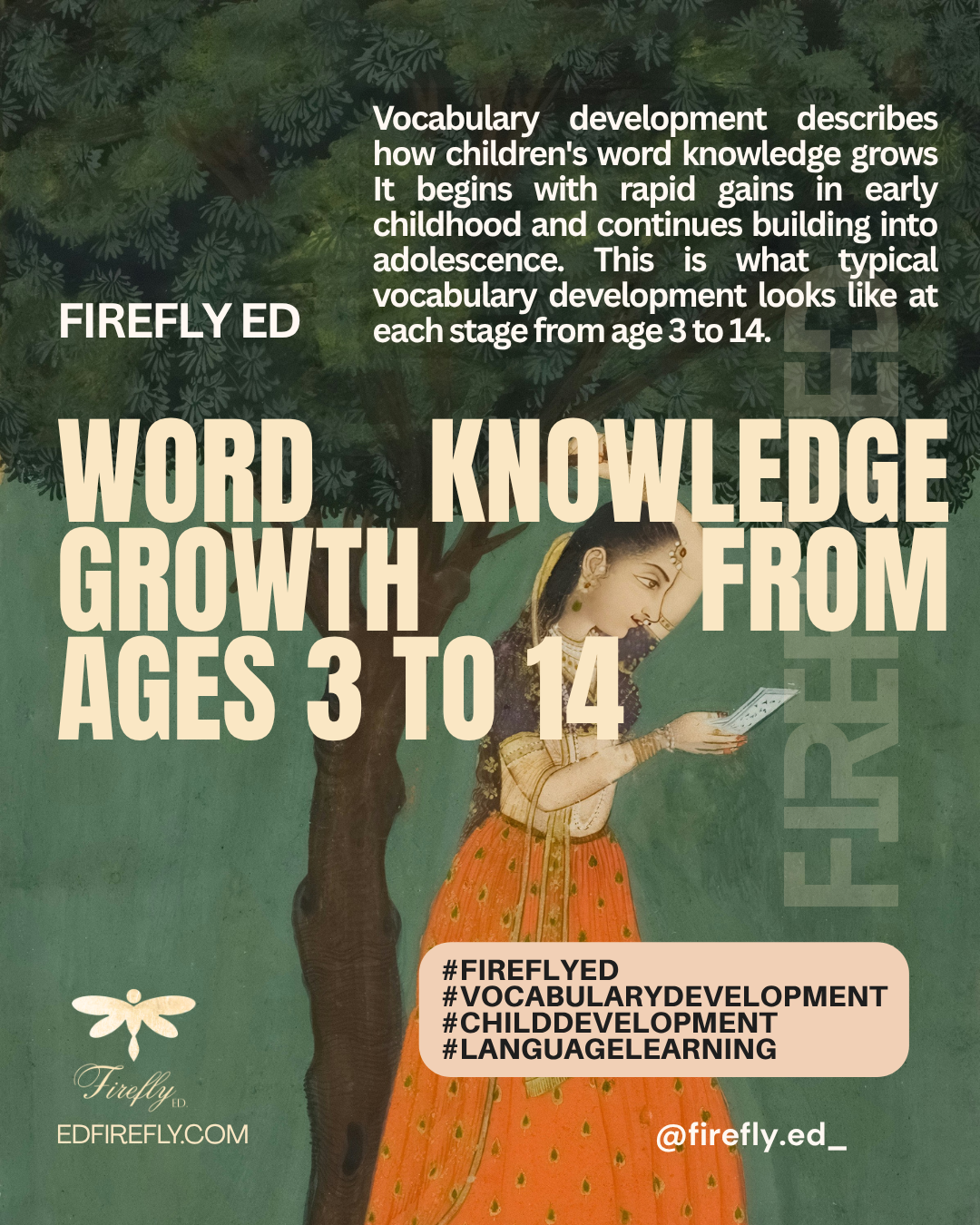
Vocabulary Development in Children — What to Expect at Each Stage
- Vocabulary development describes how children’s word knowledge grows in both quantity and depth.
- Word learning begins in infancy and accelerates rapidly between ages two and five.
- Breadth and depth of vocabulary are both important: knowing many words, and knowing them well.
- Vocabulary size is one of the strongest predictors of reading comprehension at every school stage.
- Academic and subject-specific vocabulary require explicit teaching. Conversational exposure alone does not build them.
- Slower vocabulary development may reflect limited exposure, an underlying language difference, or both.
What Vocabulary Development Is
Breadth and depth are distinct dimensions
Two dimensions of vocabulary matter. Breadth describes how many words a learner knows. Depth describes how well they know each word, its meaning, its collocations, and how it functions in context. Strong vocabulary development requires gains in both dimensions.
Receptive and expressive vocabulary develop together
Receptive vocabulary describes words children understand when hearing or reading them. Expressive vocabulary describes words they can use in speech or writing. Receptive vocabulary consistently exceeds expressive vocabulary at every stage of development. The gap narrows gradually as knowledge of a word deepens.
Vocabulary size predicts reading comprehension
Vocabulary size is one of the strongest predictors of reading comprehension. A learner who encounters too many unknown words in a text struggles to construct meaning, even with fluent decoding. Vocabulary also supports writing, listening, and spoken communication across all subjects.
How Vocabulary Develops by Age
Vocabulary development follows a broadly predictable trajectory. The figures below represent approximate norms. Individual variation is wide and depends on the quantity and quality of language exposure children receive.
Ages 3–5
The vocabulary explosion accelerates at this stage
Between ages two and five, most children acquire new words rapidly. Some add as many as five to ten new words per day. By age three, most children have a vocabulary of around 1,000 words. By age five, this typically reaches 2,000 to 3,000 words.
Children acquire new words through a process called fast-mapping. A single meaningful exposure is often enough for initial word learning. Full acquisition requires many more encounters. Knowing a word well enough to use it accurately takes repeated exposure across varied contexts.
Play and conversation drive early word learning
At this stage, word learning happens primarily through conversation, play, and shared reading. Children learn words more readily when they hear them used multiple times in meaningful contexts.
By age three, children from higher-conversation environments have heard substantially more word types than peers from lower-conversation environments. This gap has measurable effects on vocabulary size at school entry.
Ages 5–7
School entry introduces academic vocabulary
Starting school introduces children to a new register of language. Academic vocabulary includes words such as ‘predict,’ ‘compare,’ and ‘evidence.’ These appear in classroom instruction before children can read independently.
Children rarely encounter this tier of vocabulary at home. Many children meet these words for the first time at school. Direct teaching of academic vocabulary from the early years makes a measurable difference to later comprehension.
Reading begins to contribute to vocabulary growth
By age six or seven, reading begins to add words that conversation alone does not supply. Books expose children to vocabulary that is more varied and precise than everyday speech. Wide reading at this stage builds the vocabulary foundation for later academic work.
Children with richer pre-school vocabulary tend to learn new words from text more readily than those with smaller vocabularies. The gap between high-vocabulary and lower-vocabulary learners tends to widen after school entry rather than close.
Ages 7–9
Reading becomes the primary driver of vocabulary growth
Between seven and nine, children read more independently and for longer. Reading exposure becomes the primary driver of vocabulary growth. Children who read widely at this stage accumulate vocabulary significantly faster than those who read rarely.
The effects compound over time. A learner who reads widely at seven encounters many more word types by nine than a peer who reads rarely. This gap is cumulative and grows across the school years.
Morphological awareness begins to develop
Around age seven, children begin to notice that words share parts. They observe that ‘unhappy’ contains ‘happy’ and that ‘playful’ contains ‘play.’ This is morphological awareness. It allows children to deduce the meaning of unfamiliar words from their component parts.
Morphological awareness is a powerful vocabulary-learning tool. A learner who understands that ‘un-‘ reverses meaning can work out the meaning of dozens of unfamiliar words. Prefixes, suffixes, and word roots all become useful entry points into new vocabulary.
Ages 9–11
Subject-specific vocabulary increases the demand
Between nine and eleven, children encounter vocabulary specific to individual subjects. Science, history, geography, and mathematics each carry their own vocabulary registers. Schools must teach these words explicitly rather than assuming children will acquire them through exposure alone.
Words like ‘erosion,’ ‘parliament,’ and ‘denominator’ carry precise meanings within their subject areas. Learners who do not encounter these words outside school are at a significant disadvantage without explicit teaching.
Vocabulary depth becomes as important as breadth
At this stage, knowing a word superficially is often insufficient. Academic tasks require children to use words precisely, in definitions, extended writing, and argument. Vocabulary instruction should move beyond word lists toward understanding word relationships and contextual use.
Word relationship activities build depth rather than breadth. Synonyms, antonyms, and morphological families are all useful tools. A learner who understands how words relate uses vocabulary more flexibly than one who has only learned definitions.
Ages 11–14
Abstract and academic vocabulary expands significantly
Secondary school introduces abstract vocabulary with no concrete referent. Concepts such as ‘democracy,’ ‘hypothesis,’ and ‘perspective’ require a different kind of understanding from earlier vocabulary. The gap between learners with rich vocabulary knowledge and those with limited vocabulary widens considerably at this stage.
Written examinations draw heavily on academic vocabulary. A learner unfamiliar with what ‘evaluate,’ ‘justify,’ or ‘analyse’ require faces a structural disadvantage, regardless of subject knowledge. Command words in examination questions form their own vocabulary layer that schools must address directly.
Reading remains the most effective vocabulary builder
By adolescence, the vocabulary demands of academic reading far exceed what explicit instruction alone can address. Wide, varied reading remains the most effective way to expand vocabulary. Learners who read widely across genres and subjects accumulate vocabulary significantly faster than those who read rarely.
Voluntary reading tends to decline during adolescence. When it does, vocabulary growth slows. Schools and families that sustain reading habits into secondary school support vocabulary growth in ways classroom instruction alone cannot.
When Slower Vocabulary Development Signals Something More
Developmental language disorder affects vocabulary specifically
Developmental language disorder (DLD) is a condition affecting the ability to understand and use language. The condition commonly affects vocabulary development. Children with DLD may have a significantly smaller vocabulary than peers. This gap persists even with typical intelligence and adequate language exposure.
Limited language exposure produces similar patterns
Vocabulary gaps can result from limited language exposure rather than an underlying language difference. Children growing up with fewer books, fewer conversations, and less varied spoken input typically enter school with smaller vocabularies. Careful assessment distinguishes between the two.
EAL learners develop vocabulary across two languages
Children learning English as an additional language (EAL) often score lower on English vocabulary assessments than monolingual peers. Their total vocabulary across both languages may be comparable. Assessment in the home language provides a more accurate picture of overall language development.
What Supports Vocabulary Development
At Home
Conversation is the primary engine of early vocabulary growth
Quantity and quality of conversation directly influence early vocabulary development. Children who hear more varied vocabulary in conversation develop richer word knowledge. Narrating daily activities, discussing stories, and asking open questions all contribute to vocabulary growth.
Reading aloud introduces vocabulary conversation cannot reach
Reading aloud to children introduces vocabulary that everyday conversation does not supply. Books, even picture books, contain substantially more varied and precise words than speech. The benefits of reading aloud extend beyond the pre-reading years. Reading aloud to older children supports academic vocabulary development.
At School
Explicit vocabulary instruction produces reliable gains
Learners acquire most vocabulary incidentally through reading and conversation. Explicit instruction reaches words that incidental exposure alone cannot. Directly teaching the meaning, use, and relationships of target words produces reliable and transferable gains.
The most effective vocabulary instruction introduces words before learners encounter them in text. It revisits them across multiple lessons and requires learners to use them in context.
Wide reading is the most scalable vocabulary approach
A learner who reads widely and voluntarily accumulates far more vocabulary encounters than any structured programme can provide. Schools that prioritise reading for pleasure alongside subject reading create conditions for sustained vocabulary growth. Access to varied texts matters.
Vocabulary learning requires repeated exposure
Encountering a word once is rarely sufficient for full acquisition. Learners need multiple exposures, across varied contexts, to move from superficial recognition to deep knowledge. Structured review, varied practice, and use in writing all support this process.
Firefly Ed supports learners aged 3 to 14 with academic, social, and emotional development. Individual assessment and learning support address vocabulary development as a core component of language learning.
Research Sources
Vocabulary Growth and Early Development
Hart, B., & Risley, T. R. (2003). The early catastrophe: The 30 million word gap by age 3. American Educator, 27(1), 4–9.
Stahl, S. A., & Fairbanks, M. M. (1986). The effects of vocabulary instruction: A model-based meta-analysis. Review of Educational Research, 56(1), 72–110.
Vocabulary and Reading Comprehension
Tannenbaum, K. R., Torgesen, J. K., & Wagner, R. K. (2006). Relationships between word knowledge and reading comprehension in third-grade children. Scientific Studies of Reading, 10(4), 381–398.
Cunningham, A. E., & Stanovich, K. E. (1998). What reading does for the mind. American Educator, 22(1–2), 8–15.
Language Development and Learning Differences
Bishop, D. V. M., Snowling, M. J., Thompson, P. A., & Greenhalgh, T. (2017). Phase 2 of CATALISE: A multinational and multidisciplinary Delphi consensus study of problems with language development. PLOS ONE, 12(7), e0181105.




Share your thoughts or ask something..