
Guide for adults | Read this first
The Firefly Ed Grade 3 English lessons are a full year of English for children aged about 8. They follow the IB Primary Years Programme (PYP), and each lesson also links to the national curriculum for England (Year 3) and the US Common Core (Grade 3). Every lesson is free to use online, and printable PDFs are free after you subscribe.
What is in the Grade 3 lessons
There are 3 terms, 9 chapters and 108 lessons. Each chapter is one IB PYP unit of inquiry with 12 lessons. Each term ends with a four-page review.
The three levels are a guide used to plan the lessons. They are not an official standard. Most reading texts are about 250 to 500 words, and the longest ones are in Term 3.
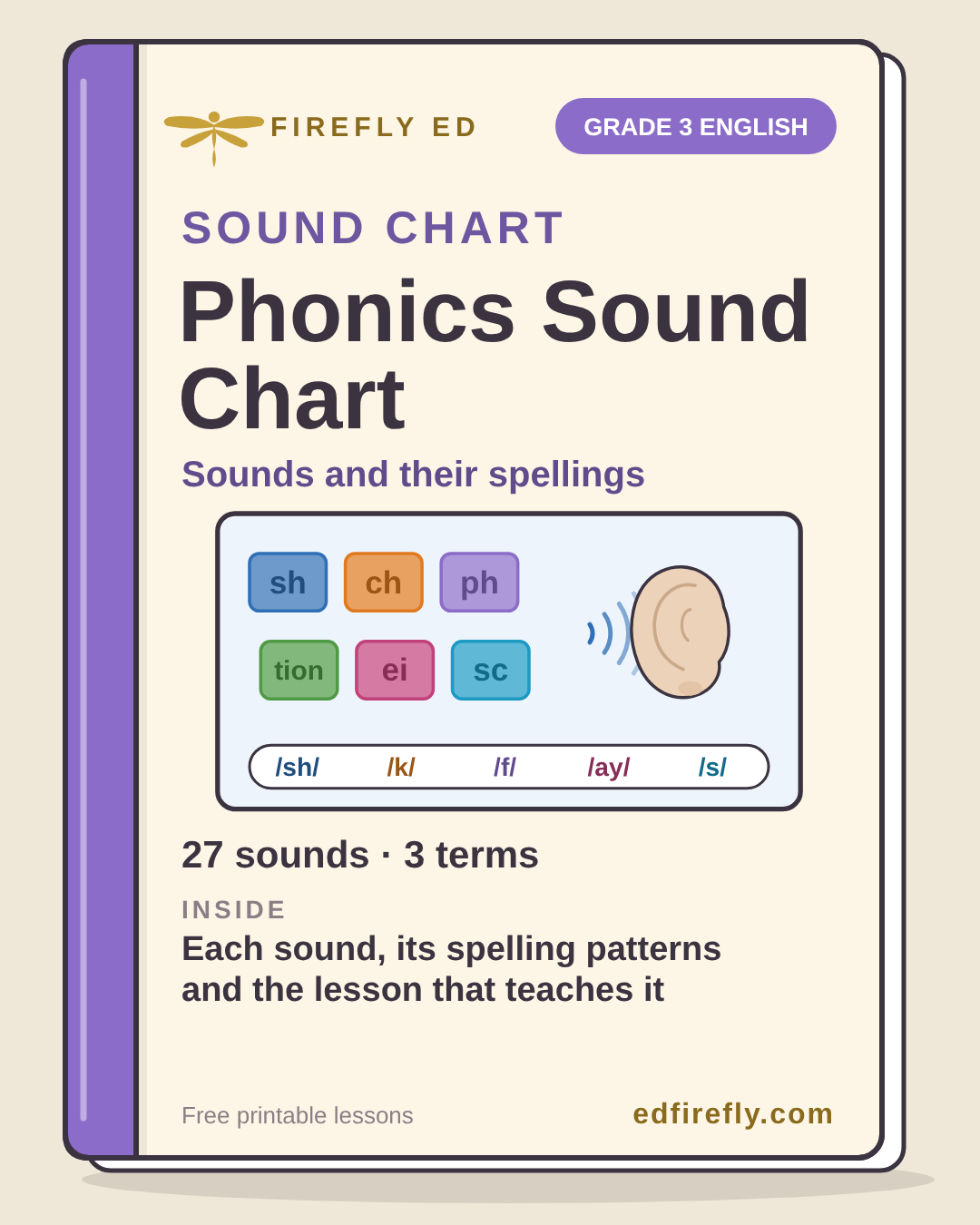
There are also three reference pages to use all year: the Tricky Word List, the Phonics Sound Chart and My Progress Chart.
The 12 lessons in each chapter
| Lessons | Strand | What children do |
|---|---|---|
| 1 and 2 | Reading | read stories, poems, reports and information texts, and answer questions |
| 3 and 4 | Writing | plan and write, such as paragraphs, reports, stories and opinions |
| 5 and 6 | Oral language | speak and listen, such as discussing, presenting, performing and debating |
| 7 and 8 | Visual language | read and make charts, maps, diagrams and designs |
| 9, 10 and 11 | Phonics and spelling | learn spelling patterns, prefixes, suffixes and tricky words |
| 12 | Chapter review | one task from each strand, and a short dictation |
After Lesson 12, each chapter has an optional Challenge: a read-aloud story with harder words, and a grammar task.
The parts of a lesson
Every lesson has the same parts, in the same order, so children know what to expect.
| Part | What happens |
|---|---|
| Goal | an I can sentence that says what the lesson is for. It is written for the child to read and say. |
| Words to know | the key words for the lesson. |
| Wonder | a big question to start the child thinking. Accept every idea. |
| Let’s Learn | the new idea, explained simply, with pictures. Read it aloud together. |
| Show How It’s Done | a worked example. Read the thinking aloud, so the child hears how to do it. |
| Try It Together | two short questions to do together. Some have a hint. |
| Time To Practise | the main tasks, for the child to do as independently as possible. |
| Reflect | a return to the Wonder question, a learner profile sentence and an idea for taking action at home. |
| Answer Key | answers and sample answers, hidden until you click Reveal Answers. Many tasks have a Look for note about what a good answer includes. |
| Next Steps | what to try if the lesson was easy, and what to go back to if it was hard. |
| For teachers: curriculum details | a closed section at the end of each lesson. It shows the unit of inquiry, key concept, learner profile attribute, approaches to learning and curriculum links. |
Each chapter also has a chapter page. It shows what the chapter is about, a Before you start activity, the questions the chapter explores, ideas for Try it at home, and the IB details. Open a lesson from the chapter page to work on it.
Notes for the adult
- Lines in slanted text that start For the adult are for you. They tell you what to read aloud, what to do and what to look for.
- When a task depends on naming a picture, a note tells you the words to say first, so that the child is not confused by a picture.
- Hints are written for the child. Read them aloud if the child is stuck.
- Checklists with tick boxes help you notice what the child did well in speaking and writing tasks.
How long does it take?
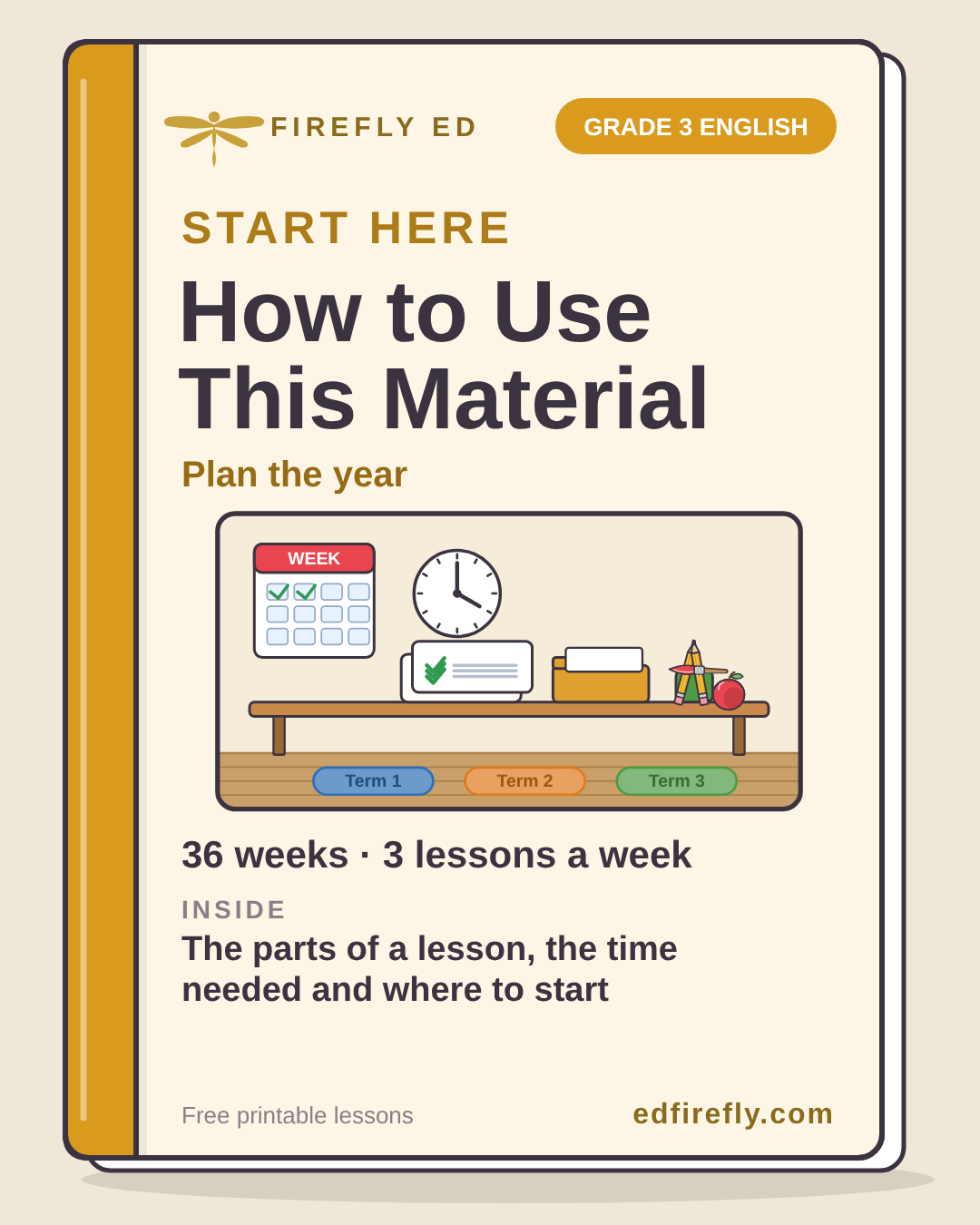
Most lessons take about 20 minutes. Writing and speaking lessons can take longer if the child enjoys them, and you can split a lesson over two days. A good pace is three lessons a week. At that pace, one chapter takes about four weeks, and the whole year takes about 36 weeks.
Working on paper
The lessons are worksheets. The child can work on paper next to the screen, or you can print the page. Lines such as ______ show where to write.
The IB PYP words
| Word | What it means |
|---|---|
| Unit of inquiry | one of six big themes, such as Who we are or Sharing the planet. Each chapter is one unit. |
| Central idea | the big idea of the unit, shown on each chapter page |
| Key concept | a question that guides thinking, such as Form (What is it like?) or Causation (Why is it like it is?) |
| Learner profile | qualities such as inquirer, thinker, communicator and reflective |
| ATL skills | approaches to learning: thinking, research, communication, social and self-management skills |
Where to start
Most children who have finished Grade 2 can start at Chapter 1. If you are not sure, try the Placement Check first. It takes about 20 minutes and shows whether to start Grade 3, or to review some Grade 2 lessons first.
You can see every chapter on the Grade 3 English index page.
Chapters – Index | Download lesson PDFs
© 2026 Firefly Ed. All rights reserved. This page may be printed for personal, home and classroom use. It may not be sold, shared online or reproduced for commercial use without written permission. edfirefly.com

Share your thoughts or ask something..