
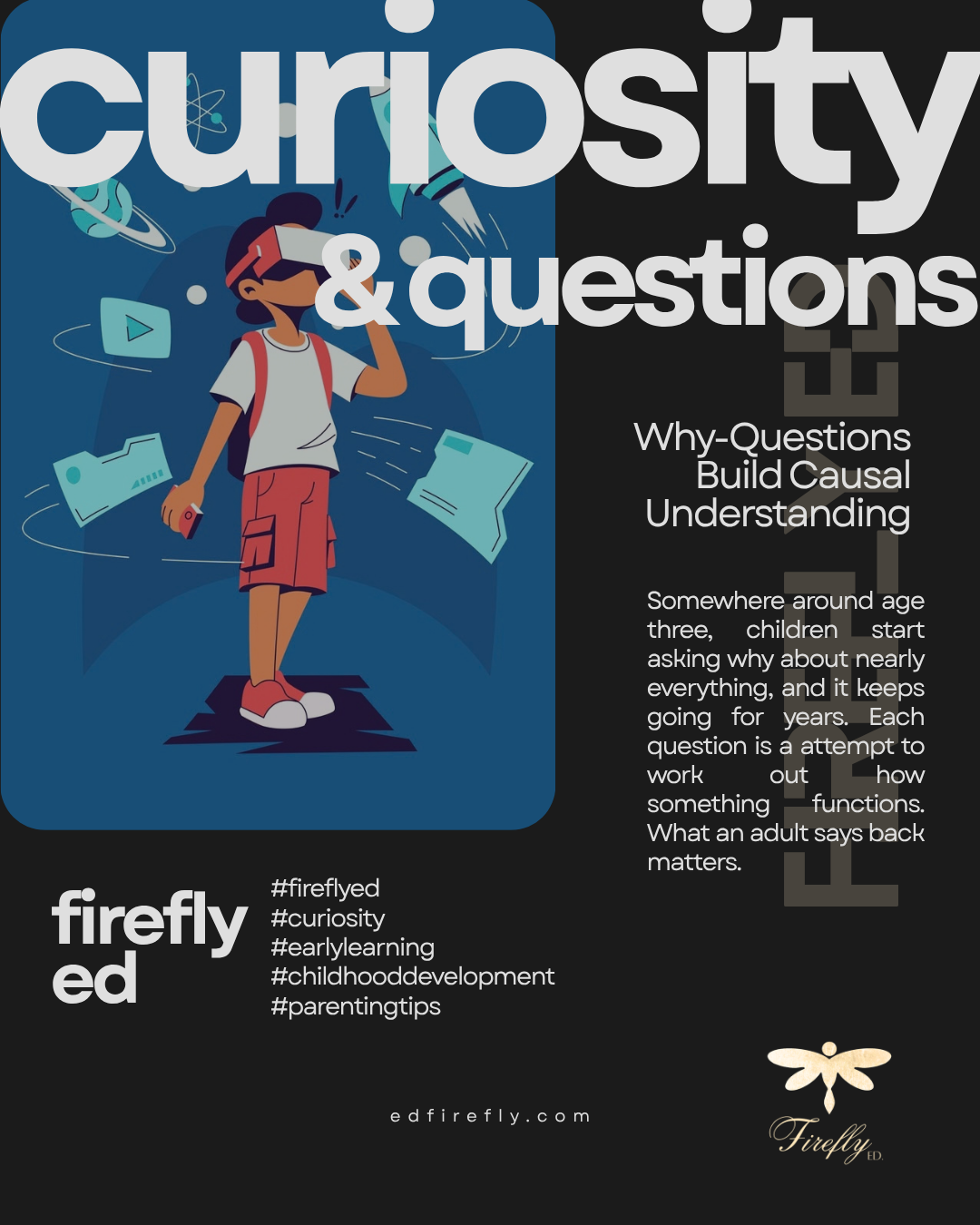
Adult Answers Decide If Curiosity Lasts
- Why-questions increase sharply between ages three and five and become part of daily conversation.
- Each why-question is a young learner testing a guess about cause and effect.
- Two-year-olds ask more follow-up questions after a vague answer than after a clear explanation.
- Question-asking drops sharply once children start school. The rate falls from about twenty-six questions an hour at home to roughly two an hour in class.
- Classroom structure accounts for most of that drop, not a loss of interest.
Why does the sky change color. Why do dogs bark. Why can’t the cat talk back. Somewhere around age three, questions like these start arriving in a steady stream. The stream is not random chatter. It marks a shift in how young children think about the world.
Why Comes After What, Where, and Who
The shift toward causal questions begins around age two
Toddlers ask what, where, and who before they manage why. Those early questions name and locate things. A why-question asks for a reason instead, and reasons take more mental work. By the end of the second year, many questions already ask for an explanation, not a fact.
Between three and five, explanation-seeking becomes the norm
Between ages three and five, why-questions turn from occasional to constant. A young learner at this age can ask dozens of questions in a single hour. The topics range from weather to death to why a sibling got a bigger slice of cake.
This is also the age when a young learner’s vocabulary catches up to their curiosity. Earlier, a toddler might point and grunt at something confusing. By four, that same confusion turns into a full sentence, aimed straight at an adult who happens to be nearby.
Why-questions cluster around a small set of recurring topics
Children this age circle back to the same handful of subjects again and again. Death, machines, family rules, and where babies come from top the list. These are the places where a young learner’s current theory runs out, so the questions keep returning until the gap closes.
What Children Are Doing When They Ask Why
Each question tests a piece of a causal model
A why-question is a young learner checking whether a guess about how something works holds up. Young children build rough theories about the world all the time. Asking why is how they test one against reality.
A young learner who asks why the ice melted is checking a theory about heat against what just happened in their hand. Each answer either confirms the theory or forces a small update to it.
Children can tell an explanation from a brush-off
Two-year-olds already notice the difference between an answer and a non-answer. Children who get a vague reply ask more follow-up questions than children who get a clear explanation. Silence does not satisfy them. They push until they get something useful back.
Children were not fussy about a perfect explanation either. A simple, honest attempt to answer worked nearly as well as a detailed one. What mattered was that the adult engaged with the question instead of waving it off.
Curiosity tracks what a young learner half-understands
Children rarely ask why about something totally outside their experience. They ask about things sitting right at the edge of what they already grasp. A why-question usually means a young learner has most of an idea and needs the last piece.
That is part of why the same question can return months later. By then, a young learner’s understanding has shifted, and the question means something new.
Which Answers Keep the Questions Coming
A rushed or dismissive answer teaches children to stop asking
“Because I said so” answers a young learner’s question in words only. It gives nothing for a young mind to hold onto or build from. Over time, children learn that asking why does not lead anywhere. They ask fewer questions. Their curiosity has not shrunk. Asking simply stopped paying off.
A single dismissive answer rarely changes much on its own. A steady pattern of them does. Children read the pattern quickly and redirect their questions toward whoever tends to answer.
Admitting not knowing keeps the question open
Adults do not need a ready answer for every why. Saying “I don’t know, let’s find out” keeps a question alive instead of closing it down. It also shows a young learner that not knowing is a normal, comfortable part of thinking.
This response has a second benefit. It models what to do with an unanswered question, which is look it up, test it, or ask someone else. Children copy that habit long after the original question is settled.
Turning the question back invites children to reason it out
Asking “what do you think?” hands the question straight back to the young learner. It turns one answer into a small investigation instead. Children who get this response tend to keep talking, testing ideas, and refining their own guess.
This works even when an adult is short on time. A quick “what do you think happens?” costs a few seconds. It still tells a young learner the question mattered.
Why Curiosity Fades Once School Starts
Questions drop from about twenty-six an hour to roughly two
At home, children ask a steady stream of questions, often more than twenty an hour. Once school starts, that rate collapses to about two questions an hour. The drop happens fast, within the first years of formal schooling.
The scale of that change stands out. A young learner who filled a car ride with a dozen questions can spend a school day asking almost none.
Classroom structure, not lost interest, drives the drop
Teachers manage large groups on a fixed schedule. The design leaves little time for open questions. Lessons tend to move toward a preset goal instead of wherever a learner’s question leads. Young learners have not stopped wondering. The school day rarely leaves room for the wondering to come out loud.
A classroom built around covering set material in a set time has little space left over. A question that wanders off script rarely fits. That pressure grows heavier the higher a young learner moves through school.
Small shifts protect space for questions
Classrooms that set aside time for open questions keep curiosity active longer. A teacher who follows a learner’s question instead of redirecting it does the same. The pattern is not fixed. It responds directly to how much room adults leave for it.
A short block of open question time, even five or ten minutes, gives curiosity somewhere to go. Small, repeated openings do more for this than one large project once a term.
What Sustained Curiosity Looks Like in Practice
At the table, follow the thread instead of closing it
A young learner asks why the moon changes shape. A quick answer ends the moment right there. Following up with “what do you notice about it tonight?” keeps the conversation moving. It treats the question as worth a few more minutes.
Walks and errands bring questions faster than answers
Walks and errands are prime time for why-questions, since a young learner’s mind is free to wander. An adult does not need a complete answer for each one on the spot. A quick “good question, let’s think about that” holds the door open until there is time to dig further.
In a classroom, one open slot changes the pattern
A teacher who opens a lesson with “what are you wondering about this?” signals that questions belong there. Even a few minutes of this, done consistently, shifts how often learners raise a genuine why. It beats waiting to be told what to think.
A deferred question still counts if it comes back around
Not every question needs an answer on the spot. Saying “let’s look at that after dinner” works fine. It only works if the adult follows through later. A broken promise teaches the same lesson as a flat dismissal.
Why This Stage Shapes Later Curiosity
Early question-asking sets a pattern that continues
How a young learner’s questions get received shapes how comfortable they feel asking questions later in school. A young learner used to getting clear answers keeps raising a hand. One used to being brushed off learns to keep questions to themselves.
Curiosity behaves like a habit, not a fixed trait
Some children ask more questions than others from the start. The amount any young learner asks still changes based on how those questions get treated. Curiosity responds to practice the same way any other habit does, growing or fading with use.
Firefly Ed runs academic classes, workshops, and events for children aged 3 to 14. Its library of articles gives parents, teens, and young adults a closer look at how learning and curiosity develop.
Research Sources
How Why-Questions Develop and Work
Ronfard, S., Zambrana, I.M., Hermansen, T.K., & Kelemen, D. (2018). Question-Asking in Childhood: A Review of the Literature and a Framework for Understanding Its Development. Developmental Review.
Frazier, B.N., Gelman, S.A., & Wellman, H.M. (2009). Preschoolers’ Search for Explanatory Information Within Adult-Child Conversation. Child Development, 80(6), 1592-1611.
Why Curiosity Fades in School
Engel, S. (2011). Children’s Need to Know: Curiosity in Schools. Harvard Educational Review, 81(4), 625-645.




Share your thoughts or ask something..