
Executive Function in Children — What the Developmental Picture Shows
- Executive function describes a set of mental skills that manage thinking, behaviour, and emotion.
- The three core components are working memory, cognitive flexibility, and inhibitory control.
- Executive function develops from early childhood through mid-adolescence, maturing more slowly than most other cognitive abilities.
- It underpins planning, focus, and the ability to shift between tasks.
- A learner can have strong reasoning ability and weak executive function at the same time.
- Many children with executive function challenges are bright, capable learners who struggle with the demands of managing their own behaviour and output.
What Executive Function Is
Three core components work together
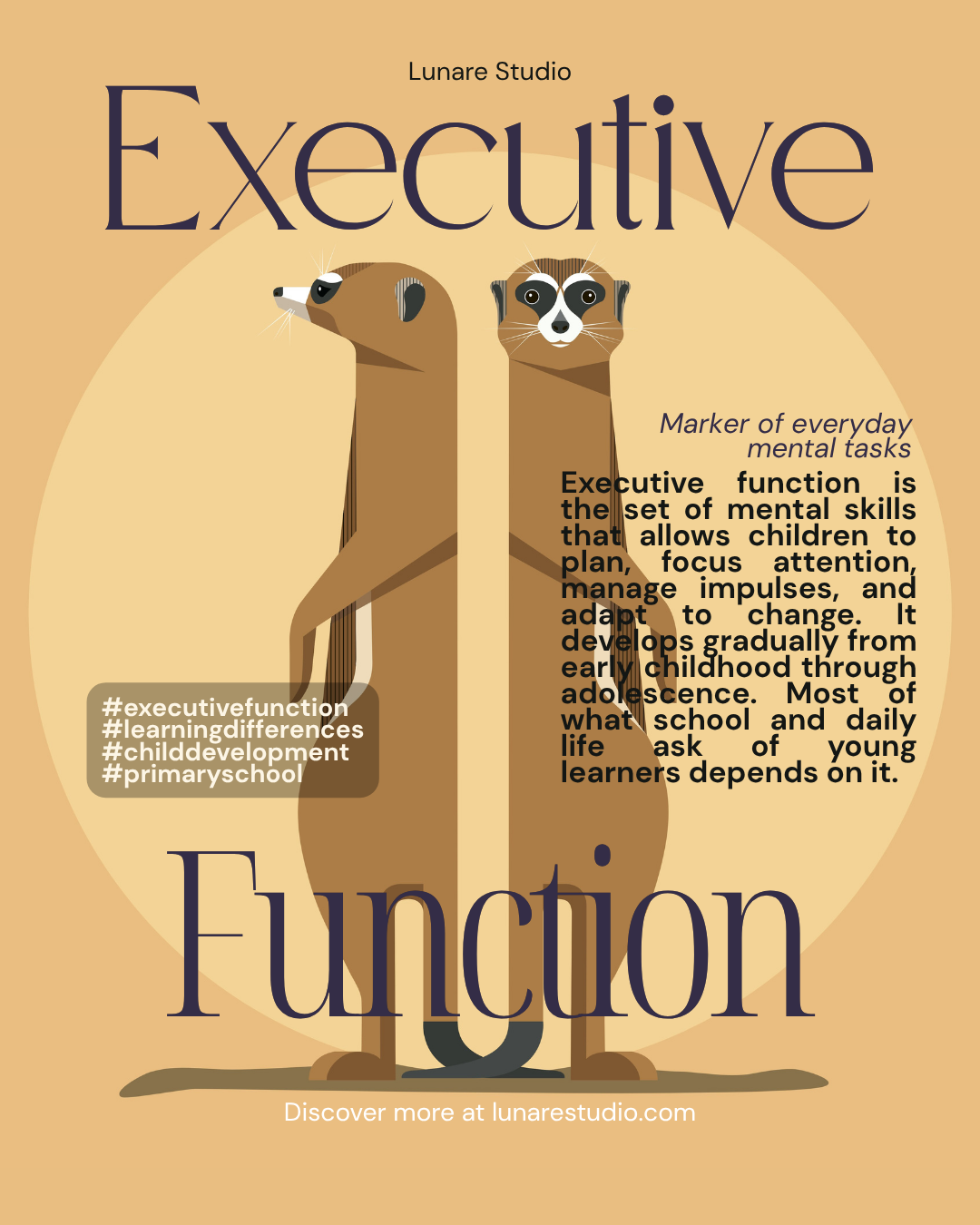
Executive function is a cluster of three linked cognitive abilities. Working memory holds and manipulates information in the moment. Inhibitory control manages impulses and filters out distraction. Cognitive flexibility allows a learner to shift attention, adjust plans, and handle change.
It operates as a management system
Executive function acts as the brain’s management system. It coordinates attention, regulates emotion, sequences actions, and monitors progress toward a goal. Most school tasks and daily routines depend on it. Starting a piece of work and recovering when a plan goes wrong both require it.
Executive function and intelligence are separate
A learner can have strong reasoning ability and weak executive function at the same time. This combination is common in learners who are both academically able and have a learning difference, and in children with ADHD. The gap between intellectual ability and day-to-day functioning is often the first sign that executive function warrants attention.
How Executive Function Develops by Age
Development is slower than most other cognitive abilities
Executive function develops more slowly than most other cognitive abilities. The most rapid growth occurs in early childhood and again in early adolescence. Full maturation extends into the mid-twenties.
This long developmental arc matters. Expectations set too early create unnecessary difficulty for children who are developing typically.
Ages 3–5
The foundations are laid at this stage
Between ages three and five, executive function develops rapidly from a very low baseline. Children begin to follow simple rules, wait briefly before acting, and shift attention between activities when prompted.
Children who develop stronger executive function at this stage tend to show better academic and social outcomes later.
What is typical at this stage
A three-year-old cannot reliably manage impulses, sustain attention, or hold a plan in mind. By age five, most children can follow a two-step rule and wait their turn in a structured activity.
Moving between tasks with adult support is also typical at this stage. Difficulty beyond this range, across multiple settings, warrants attention.
Ages 5–7
School introduces the first real executive function demands
Starting school places clear executive function demands on young learners for the first time. Sitting still and beginning a task independently are both executive function skills. For most five-year-olds, these are new demands.
Progress is visible but uneven
Between five and seven, children make measurable gains in inhibitory control and working memory. Variability within this age group is wide. Children at the same age may differ considerably in their ability to manage attention and impulse.
This variation is developmentally normal at this stage and does not, on its own, indicate a difficulty.
Ages 7–9
Planning and self-monitoring begin to develop
Between seven and nine, children begin to plan ahead and monitor their own work. They adjust their approach when a task is not going well.
A learner at this stage can begin a multi-step task and check their own answers. Recovering from an interruption without losing their place is also within reach.
Demands at school increase accordingly
Classroom expectations shift at this stage. Schools expect learners to manage longer tasks and take some responsibility for their own learning.
Learners whose executive function is developing more slowly may begin to show signs of strain. Incomplete work, frequent loss of belongings, and difficulty transitioning between activities are common indicators.
Ages 9–11
Self-regulation becomes a curriculum expectation
By this stage, schools expect significant self-regulation. Homework, multi-day projects, and time management across several subjects all require learners to work independently. These demands draw on working memory and cognitive flexibility. Both are still developing at this stage.
The gap between expectation and capacity can widen
Learners whose executive function lags behind peers face increasing difficulty as expectations rise. Work requiring sustained effort, sequencing, and self-monitoring is harder to complete independently. Parents and teachers often frame this as a motivation or attitude problem. In most cases, the pattern is developmental.
Ages 11–14
Adolescence brings a second period of executive function growth
Early adolescence is a second rapid growth period for executive function. The prefrontal cortex undergoes significant development during these years. It is the region most closely associated with planning and impulse control.
Development continues into the mid-twenties. The gap between adolescent and adult executive function remains wide until then.
Secondary school raises the stakes considerably
Secondary school demands a level of independent organisation that many young adolescents are not yet neurologically equipped to manage without support. Managing multiple subjects and social pressures simultaneously draws heavily on executive function. Learners with weaker executive function may find this transition disproportionately difficult compared to peers.
When Executive Function Challenges Are Misread
Weak executive function looks like poor behaviour
Descriptions like rude, lazy, or disorganised are common when executive function challenges go unrecognised. These descriptions locate the problem in character. The behaviour triggering them is usually a developmental signal.
In many cases, the underlying cognitive skills are still developing. For some learners, this process is slower than expected.
Emotional dysregulation is part of the picture
Inhibitory control governs emotional responses as well as behavioural ones. Children with weaker inhibitory control find it harder to manage frustration, recover from disappointment, and regulate their response to stress. Emotional outbursts in an otherwise capable learner often signal that executive function warrants attention.
It frequently accompanies other learning differences
Weak executive function is associated with ADHD, dyslexia, anxiety, and autism. It also appears in children with no additional diagnosis. Executive function is a cognitive skill that varies between learners. Identifying it changes what support is appropriate, with or without a formal diagnosis.
What Supports Executive Function Development
Structure and Environment
External structure compensates for internal regulation
Learners with weaker executive function rely more heavily on environmental structure than their peers. Predictable routines and consistent visual cues reduce the effort of organising themselves. The structure does the work that internal regulation has not yet developed to do independently.
Breaking tasks down reduces the planning demand
Long or multi-step tasks are disproportionately difficult for children with weaker executive function. Breaking tasks into smaller components and presenting them one at a time reduces working memory and planning demands significantly.
Reducing the steps presented at any one time is a change to how the task is presented. It allows the learner to access the same content with less mental effort.
Skill Building
Executive function skills can be practised
Unlike fixed cognitive traits, executive function skills respond to targeted practice. Activities that require planning and impulse management build the underlying skills gradually. Play-based approaches are particularly effective with younger children. Strategy-based games and structured discussion are useful at older ages.
Metacognitive prompts support self-monitoring
Prompting children to check their own work, reflect on what went wrong, and identify a different approach builds self-monitoring. This is one of the more advanced executive function skills.
These prompts work best when they are calm, consistent, and embedded in routine. Prompts delivered only when something goes wrong are less effective.
Firefly Ed supports learners aged 3 to 14 with academic and social development. Executive function is one of the cognitive areas assessed and supported through individual learning programmes.
Research Sources
Executive Function Development
Diamond, A. (2013). Executive functions. Annual Review of Psychology, 64, 135–168.
Zelazo, P. D., & Müller, U. (2002). Executive function in typical and atypical development. In U. Goswami (Ed.), Blackwell Handbook of Childhood Cognitive Development (pp. 445–469). Blackwell.
Executive Function and Learning Differences
Barkley, R. A. (1997). Behavioural inhibition, sustained attention, and executive functions: Constructing a unifying theory of ADHD. Psychological Bulletin, 121(1), 65–94.
Willcutt, E. G., Doyle, A. E., Nigg, J. T., Faraone, S. V., & Pennington, B. F. (2005). Validity of the executive function theory of attention-deficit/hyperactivity disorder. Biological Psychiatry, 57(11), 1336–1346.
Intervention and Support
Diamond, A., & Lee, K. (2011). Interventions shown to aid executive function development in children 4–12 years old. Science, 333(6045), 959–964.


Share your thoughts or ask something..